
ChatGPT Ads Are Coming. Here’s What Actually Matters


TL;DR
- ChatGPT ads are coming. They're B2C-first, US-first.
- Ads won't influence the answers themselves (yet).
- Advertisers won't see the exact prompts users type , just like there's no GSC for ChatGPT today.
- We're very skeptical about whether the ad controls and analytics will be good enough for B2B.
- For B2B organic AI search: no major impact expected right now. But start tracking ads immediately.
What changes when ads sit inside AI answers
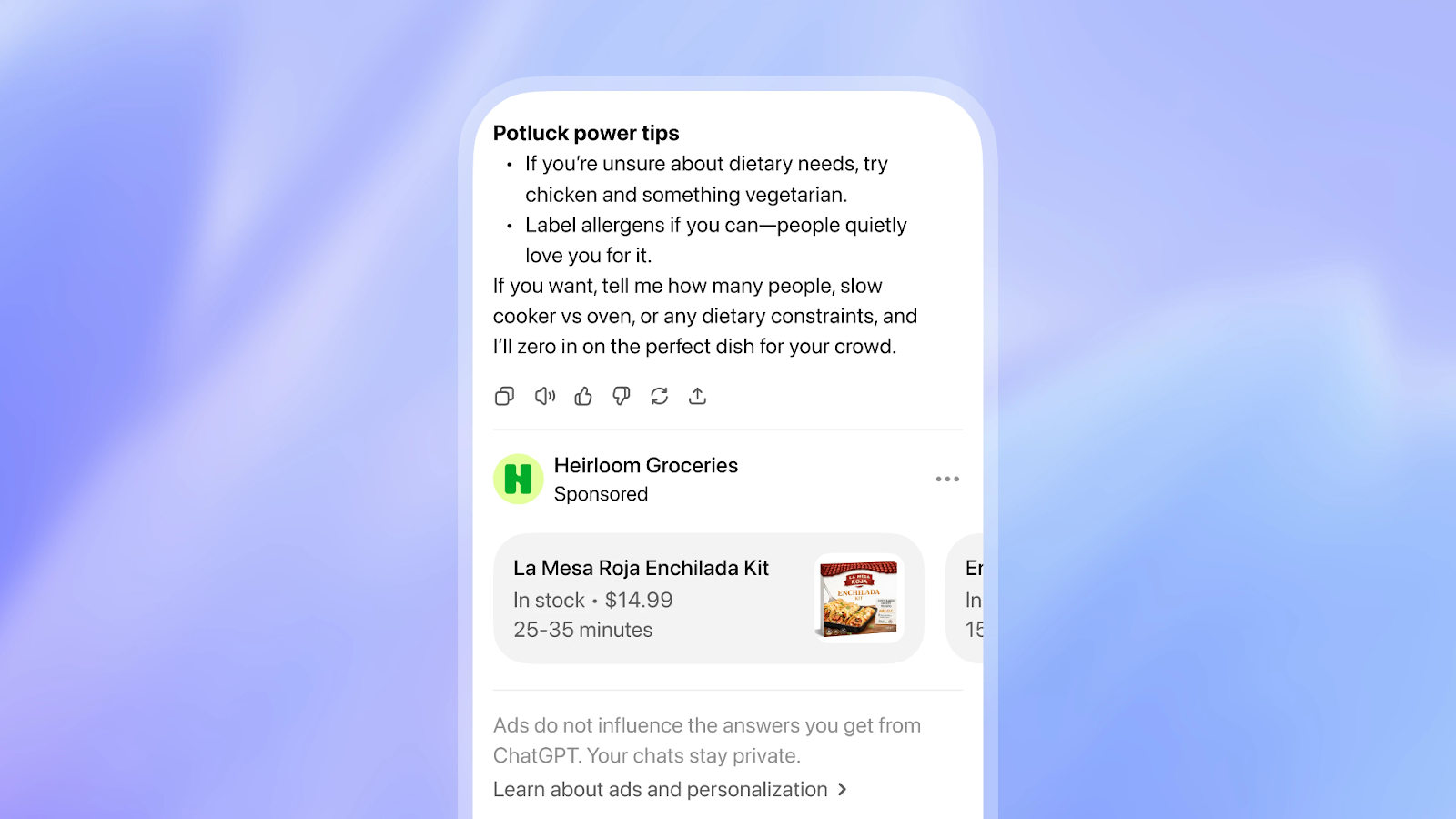
This wasn't curiosity for the sake of it. We started looking at ChatGPT ads for a very specific reason.
No tool today has an extremely reliable way to understand the search volumes ChatGPT searches. We were(still are) hoping to see if we can leverage the analytics we see in ChatGPT ads to estimate search volumes.
You can do the same thing today in Google ads. If you run Google Ads, in its analytics you get two metrics: impression share and total impressions. If you divide one by the other, you get the actual number of impressions, which is essentially the real search volume. That's the most accurate way to get search volume for things you aren't ranking for, much more accurate than any keyword planner.
We wanted to know: could a similar exploit exist in ChatGPT ads?
The second reason is much simpler. We wanted to understand how the search experience changes once ads are in the same interface as AI-generated answers. Because once that happens, user behavior shifts. And when user behavior shifts, everything downstream changes, i.e., how people search, what they click, what they trust.
We've been collecting information from every source we can find. Articles, podcasts, basically a lot of stuff. This article is everything we’ve inferred before anything has been officially released.
What OpenAI has confirmed and how this will likely evolve
From their official announcement
- They’re focused on B2C ads. Makes sense. That’s the majority of their user base.
- The answers won’t get influenced by ads. Yet. The model will use whatever information it has to generate the answer. It won’t “know” what ad is being shown alongside it. At least, that’s the claim right now.
- Advertisers won’t see the exact prompts they’re bidding on. Just like we don’t have a GSC for ChatGPT, advertisers won’t get prompt-level data either.
- Rolling out in the US first, then other regions.
- It’s easy to spot what’s an ad vs. what’s an answer. For now. That word “for now” is doing a lot of heavy lifting.
- It’s just product placement for now, but will evolve into conversational ads very soon. This is the part worth watching.
- In every mockup, only a single company’s products were showcased. That definitely shouldn’t be the case. Either they’ll change this to recommend multiple companies(ads) at launch or soon after.
From other ad platforms’ history
If you’ve watched how ad platforms evolve, some patterns are almost guaranteed:
- They’ll be cheap early on, then get expensive. This is the cycle with every single ad platform.
- High CTRs early, then users learn to ignore them. Same story, every platform.
- Ads will get harder to distinguish from the answer itself. It happened with Google. It’ll happen here.
How ChatGPT ads will actually function
After reviewing OpenAI’s materials and recent podcasts, here’s our current working model of how this will function.
1. Advertiser data and targeting
Advertisers will not get to see the actual conversations. As expected.
The model will use the information it has to generate the answer. It won't "know" what ad is being shown alongside that answer. What's not clear yet is what signals the ads model will use to decide which ad to show.
Our best guess: it won't use fewer data points than what the model already uses to generate answers. That means not just the prompt, but also user information like location and preferences based on history. Also, ad engagement behaviour.
Where it gets tricky is MCP and connectors. As ChatGPT integrates with more tools and data sources, the model will be able to "see" more about the user. Our guess is that the LLM decides what information to use for the answer, and the ad engine takes an abstraction of that, likely whatever the LLM actually used to generate the response.
2. User profiles
Here's a subtle point. ChatGPT now has an added incentive to build more extensive user profiles.
But honestly, the amount of information needed to create a genuinely useful AI assistant (which is what they'd want to build) probably already has more than what they'd need for ads.
3. Personalization vs. creepy
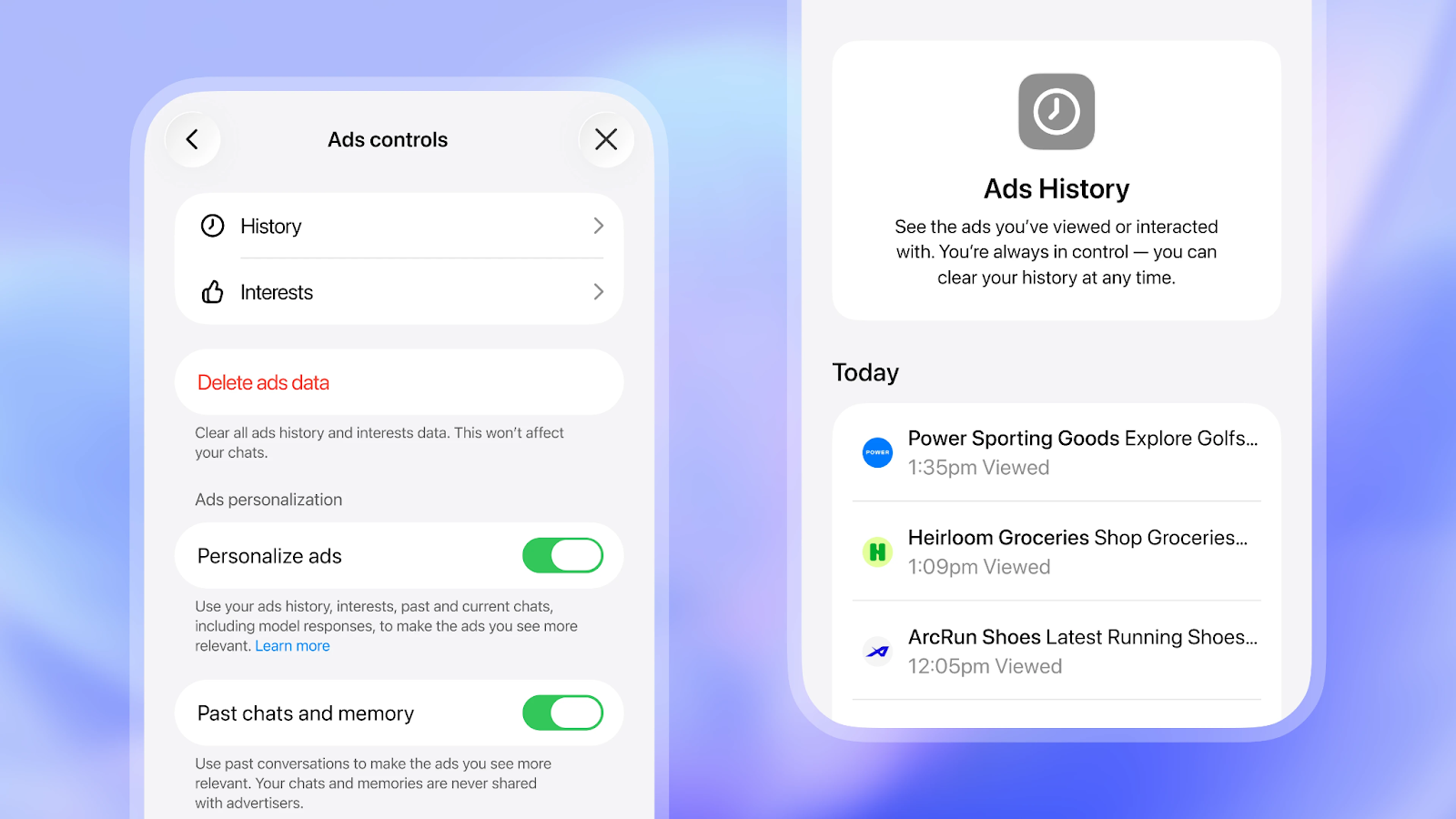
From one of the signals we found: "If I have a trip planned to X, it'll show me ads for camping gear because it knows that's what I like."
This is exactly the line OpenAI will need to navigate: how to use personalization to be genuinely helpful without crossing into territory that feels invasive.
4. Transparency and controls
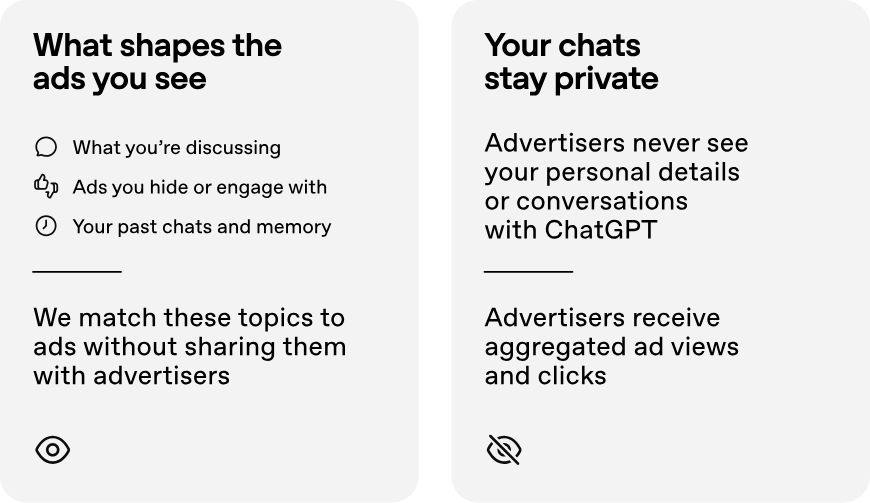
We expect they'll need to show users what they know. And give controls like:
- What "parts" of your data are used for ad targeting
- The ability to clear history
- An option to say "don't use my past conversations"
That word "parts" is going to be very important. Both for advertisers trying to understand targeting and for users trying to understand what they've opted into.
5. Ad interaction data feeds back into the model
They'll be collecting ad interaction data to improve targeting. This is standard for every ad platform. Click-through behavior, engagement patterns, conversion signals, all of it will loop back into better ad matching over time.
How ChatGPT ad inventory compares to other platforms
Every ad platform's inventory model is shaped by how users interact with it. Here's how ChatGPT compares:
ChatGPT targeting won't look like Google (keywords) or LinkedIn (audiences). It'll be intent-driven.
And many "ads" will probably be mini ChatGPT apps, i.e., your data plugged into a conversation. Not a banner. Not a text ad. Something closer to a product experience embedded inside the chat.
Retargeting is still unclear. It will become more relevant once ChatGPT expands beyond simple chat interactions.
Why B2B won’t move fast on this, but should still prepare
Let's be direct about this.
B2C will feel the bigger impact
That's where the volume is. That's where the ad product is designed for. Consumer purchase decisions made inside ChatGPT like travel, shopping, local services, will be the first to see ads affect the experience.
B2B? Minimal impact on organic (for now)
We're very skeptical about ChatGPT ads being good for B2B specifically. The controls and analytics needed to run good B2B ads like account-level targeting, pipeline attribution, audience segmentation by company size or role, are probably not going to be there at launch. And maybe not for a while.
B2B ad buying is fundamentally different from B2C. You're not optimizing for clicks. You're optimizing for pipeline. And until ChatGPT's ad platform can give B2B marketers the right controls and the right measurement, we don't see it being a serious channel for B2B advertising.
That said, we will be tracking whether ads start appearing in B2B-related prompts.
ChatGPT Ads long-term impact on search and marketing
Here's the part we're most focused on.
Everything above is about what's happening this quarter. What actually matters is what this unlocks next year.
ChatGPT is testing new ad patterns. Perplexity, Claude, and Google will follow. Google is already testing ads inside AI Mode.
When Google fully replaces traditional search with an AI-first experience in the next 12–24 months, ads stop being a channel tweak. They become part of the answer layer itself.
That's when this actually changes how marketing works. Not because there's a new ad unit. But because intent, trust, and narrative all converge in one place. And teams built to run isolated channels will feel that shift first.
For now, you can focus on organic AI search, check out Chosenly for that. It’s the best tool on the market for AI search by far. We’ll be happy to give you a walkthrough.
And the moment these ads are released, Chosenly customers will be the first to know what's actually happening, and what to do about it.
But if you ask me whether ChatGPT ads will matter for B2B this year? Probably not. But the moment they get released, you'll want to have been tracking from day one.