
GEO Strategy Guide 2026 (5 Step Framework for B2B)
The 5 step framework to to do GEO (generative Engine Optimization right.


Here's the GEO strategy most people end up with after scrolling LinkedIn or X long enough:
- Do more Reddit
- Create more content
- Create a Wikipedia page
- Create an LLMs.txt file
- Add schema markup to all your pages
3 to 5 have almost no meaningful impact on whether you show up on AI search. 1 and 2 are too vague to actually act on.
In this article, we'll use our experience working with 30+ B2B companies to help you figure out the top 3 levers your brand should actually focus on to show up when buyers ask AI tools for a recommendation. Something like this:
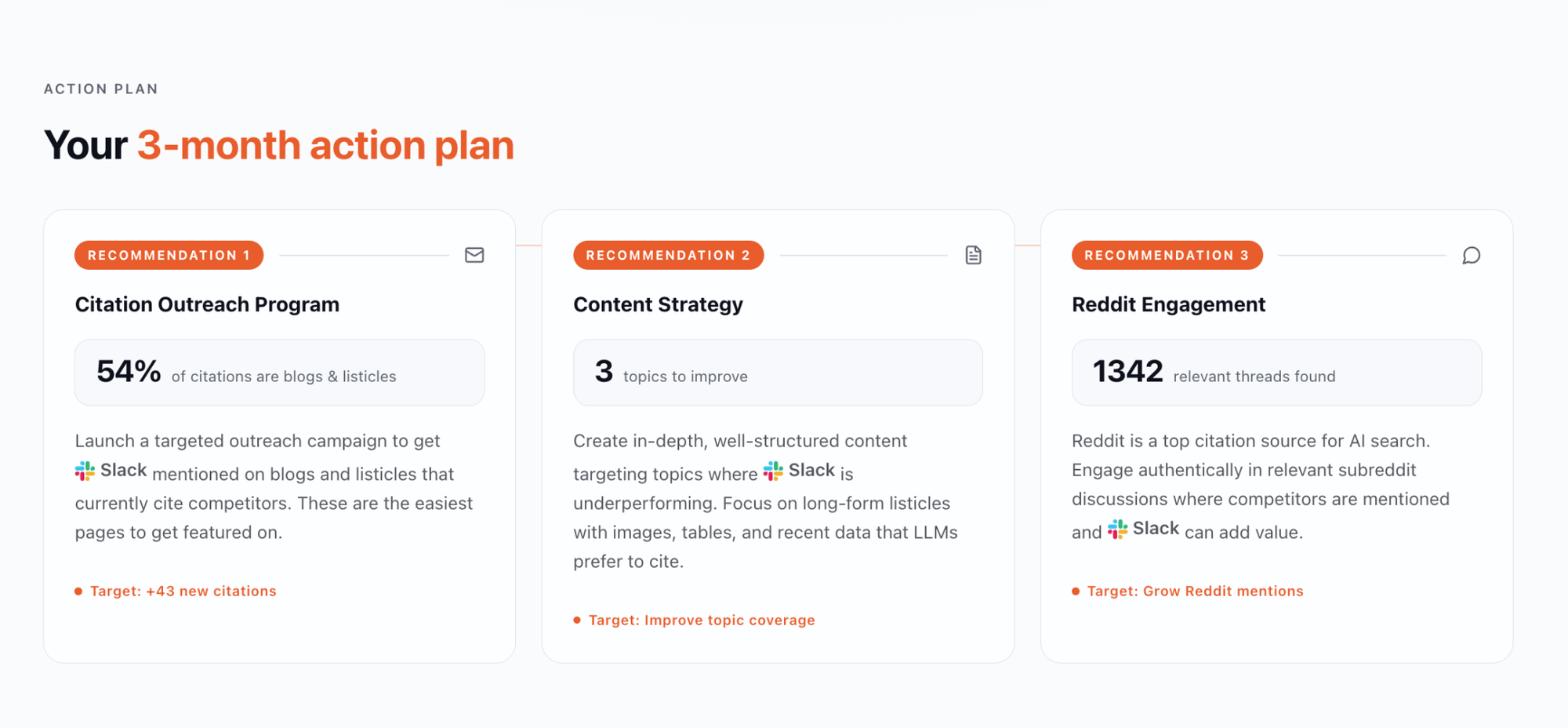
This article is something you follow along with, not skim once and forget. If you don't have a couple of hours, bookmark it and come back when you do.
TL;DR: How to build a GEO strategy from scratch
Most GEO advice tells you to do more Reddit, create more content, or add schema markup. That is not a strategy. A real GEO strategy for B2B starts with data, i.e., understanding where you stand in your category and identifying the specific actions that will move the needle for your brand.
Core Principles of Generative Engine Optimization
Before we deep dive into the GEO strategy guide in SEO, you need to understand 3 things:
1. The goal is to get mentioned, not referenced
A lot of people working on GEO are tracking the wrong thing. The goal isn't to be "cited" by LLMs in the technical sense. It's to be mentioned, in the actual answer, by the AI, when your buyer is asking which product to use.
What actually happens when a potential customer asks ChatGPT "what's the best tool for project management?" They're not reading a list of sources at the bottom of the answer. They're reading the answer itself and they're acting on the first two or three names they hear.
The goal is for ChatGPT to say: "You should consider working with this company" or "use this software." That recommendation, in the answer, has a direct correlation with the number of demos you get and the pipeline it generates.
2. There can be infinite variations of prompts
For B2B, plain prompt tracking doesn’t work. Buyers phrase things differently every single time:
- "Best project management tools for remote teams."
- "Which software helps with sprint planning?"
- "Alternatives to Asana for a startup."
Nobody types the same thing twice. For B2B, prompt tracking does not work. Instead of trying to track full prompt variations, focus on your seed keywords i.e., the base categories and criteria your buyers search for. Any single seed keyword can generate hundreds of variations. There is no point tracking them all.
Want to learn more about prompt tracking? Read it here: https://chosenly.com/blog/llms-are-inconsistent-are-ai-search-tools-even-useful/
3. Only track prompts where a vendor actually gets recommended (BoFu)
There are really only five types of searches where an LLM will recommend a product at all:
- Recommend a vendor for [need]
- Can [type of tool] help me with [job to be done]?
- Give me alternatives to [competitor]
- Help me choose between [Company A] vs [Company B]
- Tell me about [specific company]
Everything else including the "what is" questions, industry explainers, strategic frameworks, the LLM answers itself without recommending anyone. If you track those alongside purchase-intent searches, your visibility metric goes wrong, your rank metric goes wrong, and everything you are using to measure progress becomes inaccurate.
If you look closely, the above five types map almost exactly to your bottom-of-funnel SEO keywords.
How to create a GEO strategy?
Step 1: Get the right data in front of you
Before you run any analysis, make five decisions upfront. Getting these wrong skews everything that comes after.
A. Which LLM to track
Don't try to track all of them at once. If you track too many at once, it gets distracting and no one implements anything. There is no point adding that level of complexity before you have a working system.
Start with wherever your traffic is already coming from. Check your analytics and look for referrals from AI sources. If you can't tell, start with ChatGPT. It has the highest share of AI search traffic by a wide margin. You can expand to Perplexity, Claude, and Gemini later once you have momentum.
B. Region
AI search results vary by geography. LLMs change their answers by region significantly, even more so than Google already did. Define your target region upfront and stick to it. Again, start narrow, expand later.
C. Your prompts
Use the five prompt types above as your framework. Build your list using your seed keywords (the categories and use cases your buyers search for) combined with the criteria they care about.
D. Competitors
List the companies you want to track alongside yourself.
E. Personas
Define the buyer types you care about. This matters most in later steps when you're looking at positioning, different personas use different criteria to make decisions, and you need to know which ones you're trying to win.
Once you have these five inputs, connect your Google Search Console to Chosenly and it generates your GEO report. Your seed keywords, competitors, region, LLMs, and personas become the foundation for Step 2.
Step 2: See where you actually stand today
Before you touch a single piece of content or send a single outreach email, you need to know exactly where you are today. There are two things that tell you everything:
2A. Visibility and rank:
There are two numbers that tell you everything:
How often you show up (visibility %): Visibility is what % of the purchase-intent searches in your category are surfacing your brand at all. When a buyer asks ChatGPT for a recommendation and your name does not come up, you are not on their shortlist.
Where you appear when you do (rank): Rank tells you how high you show up when you do appear. Buyers asking ChatGPT for a recommendation are acting on the first few names that appear. Rank matters more than people think. ChatGPT does not always recommend 7, 8, or 10 companies. Sometimes it only recommends 2 or 3, depending on the intent of the prompt. When you are ranked higher, you show up more often because you do not get cut off when the list is short.
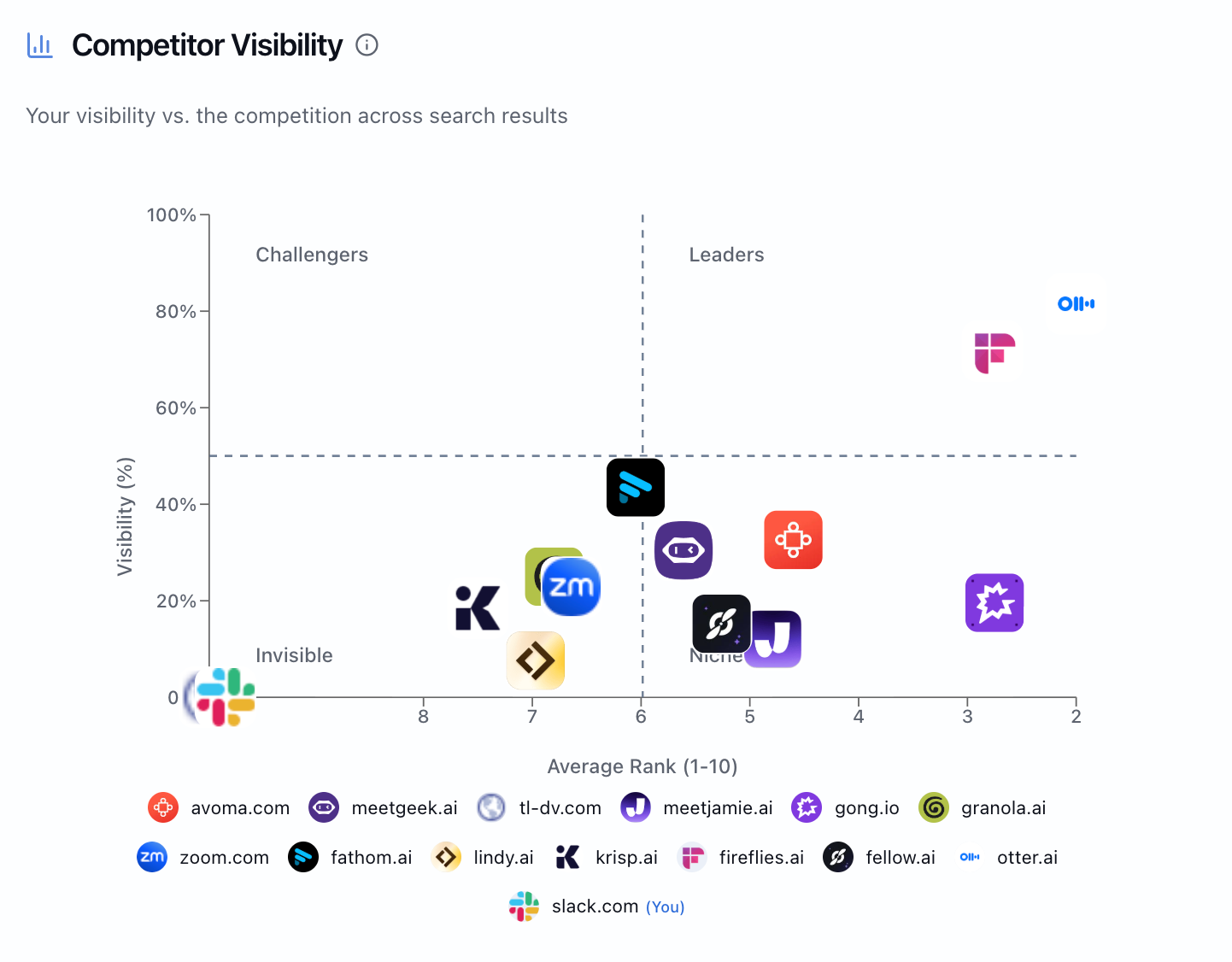
To know where you stand, open the Analytics tab in Chosenly. The first thing you see is a 2D graph plotting every company in your category (yours and every competitor) by how often they show up and where they appear when they do. Companies cluster into four quadrants: Leaders, Challengers, Niche, and Invisible. Find where you sit. That is your starting point.
2B. How you perform across topics
Your overall visibility number doesn't tell the full story. Break it down by topic and you'll see exactly where you're showing up, where competitors are dominating, and where nobody has claimed the space yet. That topic-level view is what turns a vague visibility score into a specific list of gaps to close.
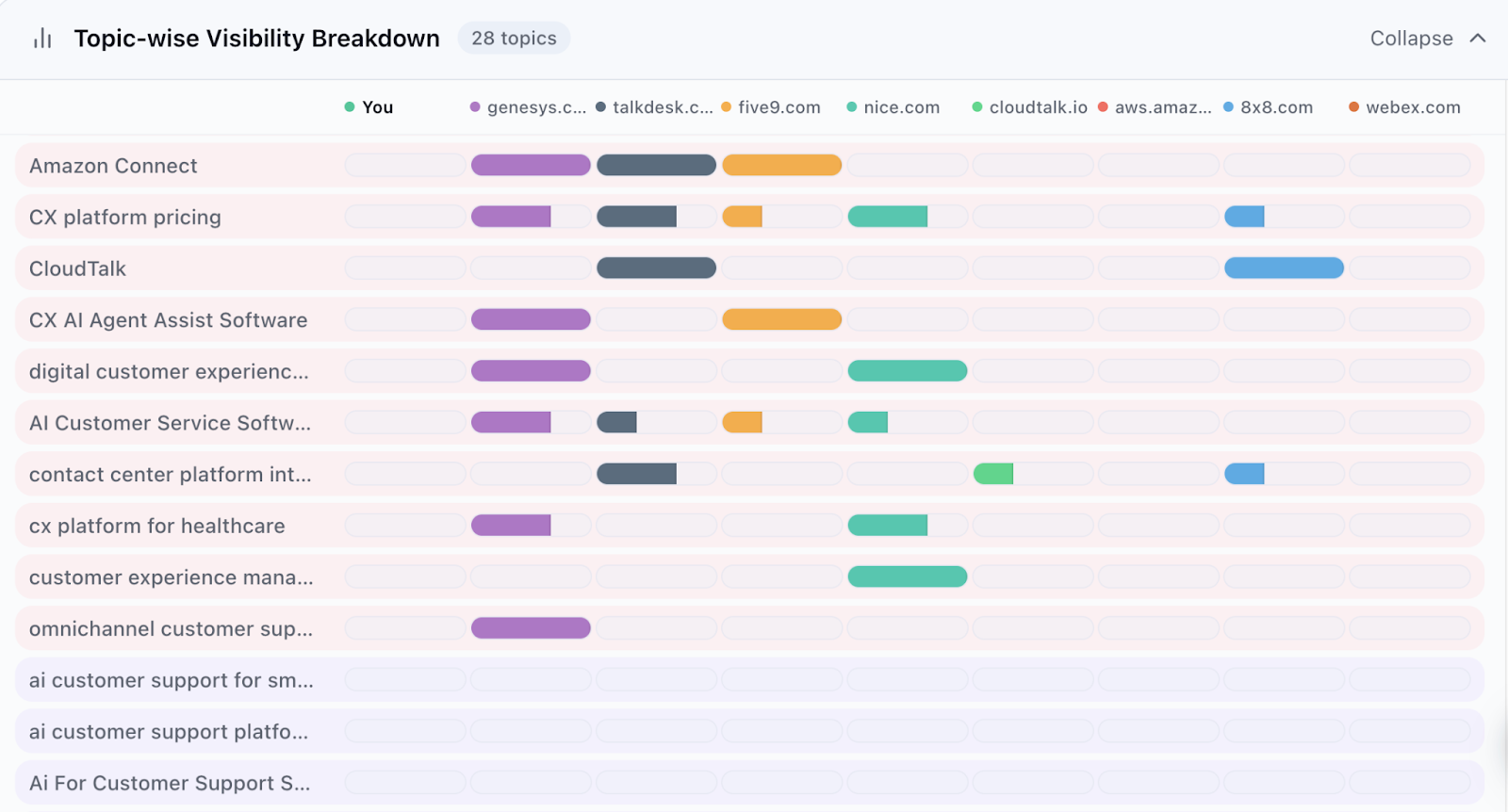
You can check this manually by running your prompts on ChatGPT and noting your rank and visibility per topic. When you do, make sure to use temporary chat. If you've been researching your own industry, ChatGPT has learned your patterns and will surface more flattering results than a real buyer would see. Temporary chat gives you the unbiased picture your customers actually get.
For example, Spear Growth offers ads, SEO, content, and video services. Its overall visibility might look average, but broken down, it might rank among the first agencies recommended for ads-related searches, while barely showing up for SEO. That gap is exactly what you'd want to act on.
Every month we build 10 GEO strategies for free
Step 3: Know what to do for each indicator
This step tells you what's actually driving results for the companies ahead of you, and which of those levers you can pull.
Look at each of these in order.
3A. Outreach
The single strongest predictor of how often an LLM recommends you is how often your brand is included in the URLs those LLMs reference when generating their answers.
In every category we've analyzed, the companies that show up most frequently as top results also have the highest share of brand mentions across the pages LLMs reference.
What to look for:
When you open the Outreach tab in Chosenly. The first thing you see is three numbers: Total Citations, Your Citations, and Competitor Citations.
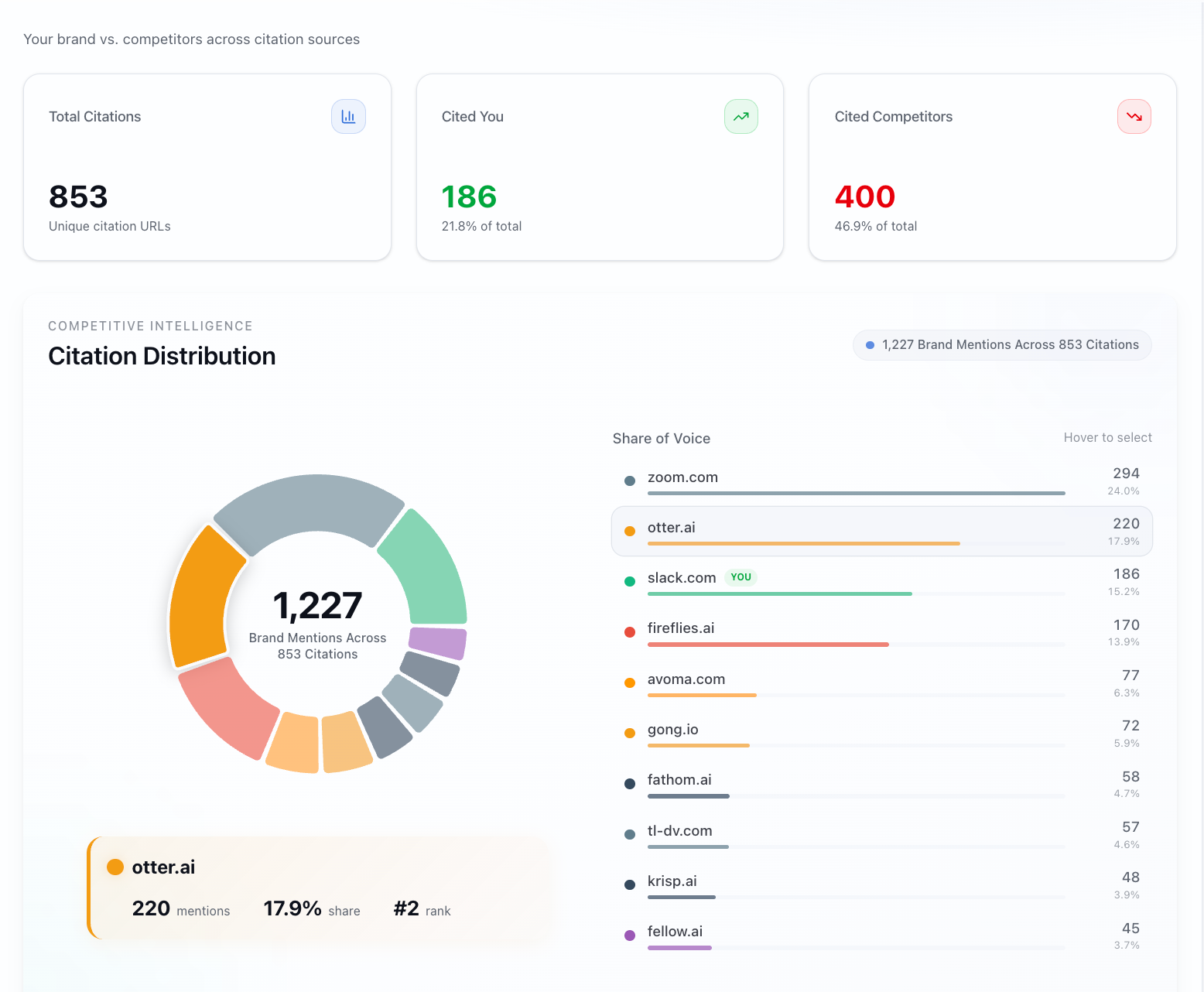
Below that is the Citation Distribution chart, a donut showing Share of Voice broken down by company.
Ask three questions about what you see:
- Where do I stand right now: What percentage of total brand mentions across all referenced URLs belong to you?
- Who's at the top: In most categories, the company with the highest share of references is also the company that shows up first, most often. It tells you what the ceiling looks like in your space and that shapes how aggressive your plan needs to be.
- Who's closer: The more useful number is usually the company just above you. Knowing who you can realistically overtake, and who might overtake you if you stay still, is what turns this into a plan.
Type of pages:
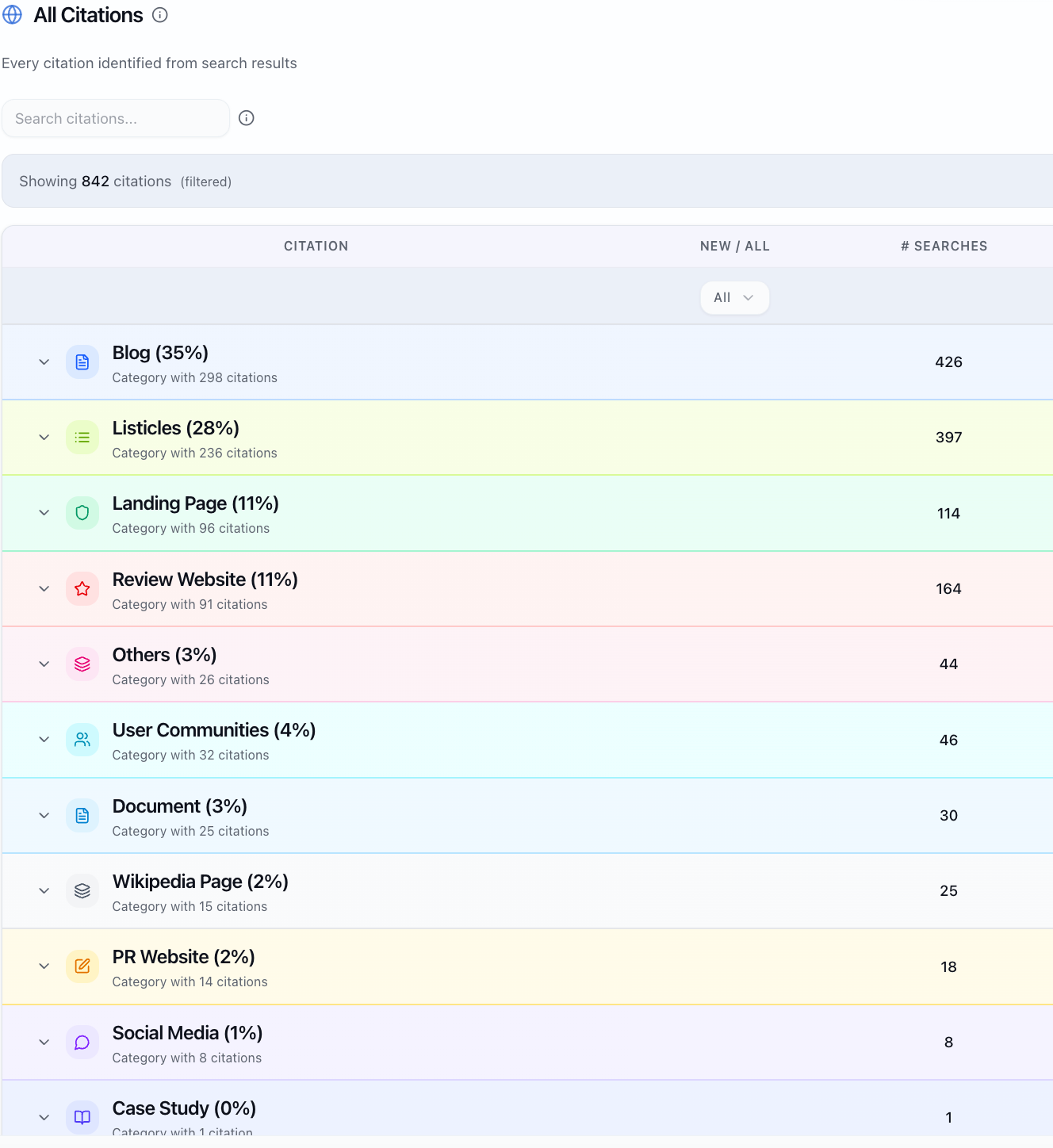
In most B2B categories, listicles and blogs together make up two-thirds of the pages LLMs pull from. That ratio matters because those are the pages you can actually get included in. Landing pages belong to competitors. A PR article published two years ago isn't being updated. A Gartner report might reference you, but that requires relationships and often significant investment. In contrast, a blog or independent listicle can be acquired through direct outreach.
🎯 Action plan: If you see that the top companies being mentioned in your category are also the ones with the highest share of referenced URLs, prioritize outreach. Find the listicles and blogs that already include three or more of your competitors but not you. Those are your highest-confidence targets. Reach out to the authors, make the case for being included, and get placed.
For a detailed step-by-step guide on how to find the right urls, who to contact, how to negotiate and secure placements, read our blog on how to get listicle & citation placements for ai seo visibility
3B. Content
Beyond getting mentioned in other people's pages, there's a second path: creating your own pages that LLMs pull from directly.
This takes more time to build, but it keeps growing over time. The companies that stay on top in any category usually have strong content programs.
To arrive at this decision:
See whose content is already being referenced:
The companies that show up as dominant players almost always have their own content programs that are actively referenced.
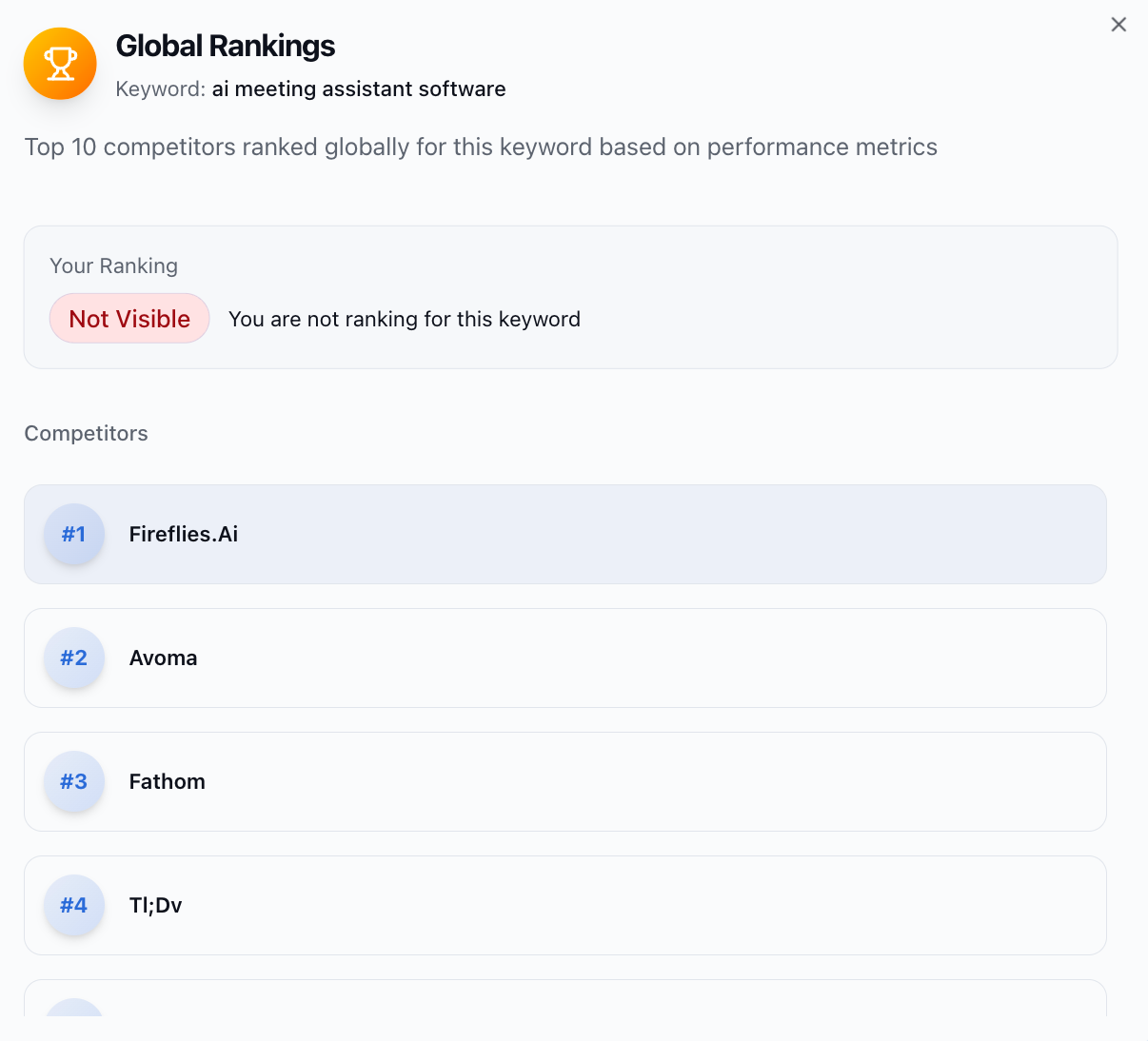
In the above AI note-taking example, Tl;dv, Avoma, Read.ai, all have their own content showing up in the pages LLMs reference and that's helping them rank above companies with weaker content programs.
What kind of content actually gets referenced:
The content that gets referenced most tends to be in-depth, well-structured, recently updated, and rich with screenshots and video embeds.
In our AI note-taking example, it's the content from Tl;dv, Avoma, Read.ai, Lindy, and Jamie that fits this description, and those are the same companies breaking through in recommendations.
Every piece should also have something a reader can't find anywhere else: unique insights. Generic well-formatted content is less likely to be referenced than content that adds something new.
🎯 Action 1: Look at what kind of pages are being referenced in your category. If listicle-style content dominates, that is where you should put your effort. That is the format that gets referenced most. Make it in-depth, well-structured, recently updated, and rich with screenshots. Add at least one unique insight that a reader cannot find anywhere else.
🎯 Action 2: Check if the pages being cited are recent. If most of them are recent, that tells you recency is a signal that matters in your category. In that case, refreshing your existing content with new data or examples is often more valuable than creating something new.
🎯 Action 3: Look at whether platforms like LinkedIn Pulse or Medium are showing up repeatedly as referenced sources in your category. If they are, publishing a version of your existing content on those platforms means you get referenced in more places without writing something from scratch.
P.S. - We are writing a full-fledged on GEO content strategy guide. Stay tuned.
3C. Review Sites
Look at which review sites are being referenced in your category, and check if you have a presence on all of them. Most companies only invest in G2 and Capterra. But sometimes LLMs pull from a much broader set of platforms.
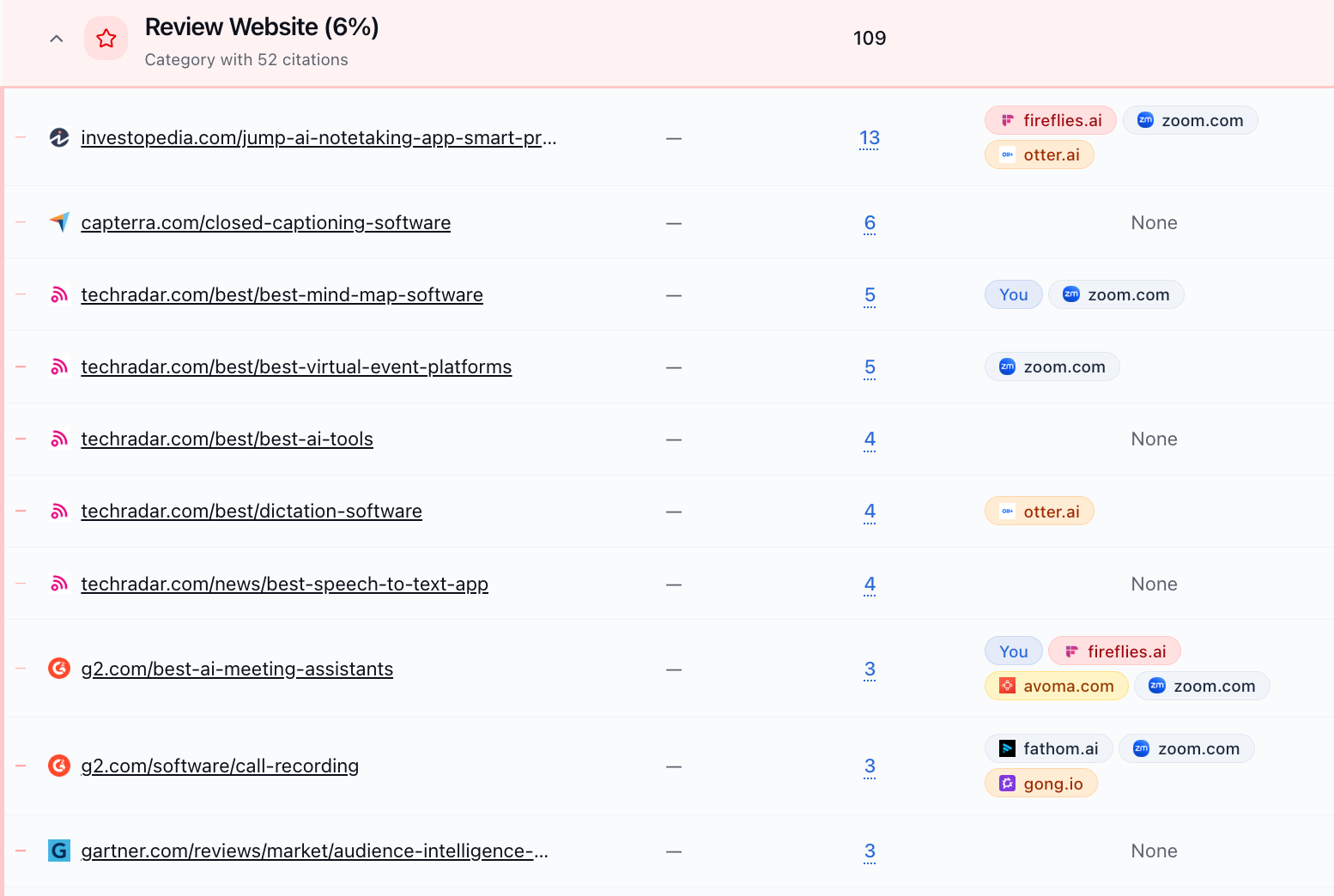
🎯 Action 1: Look at which review sites are being referenced in your category beyond G2 and Capterra. If you do not have a presence on the niche ones, go get listed. The bar is very low. If everyone on a niche review site has three reviews and you get four, you are the top-ranked software on that platform. For LLMs, more reviews are always better.
🎯 Action 2: For every platform you are already on, check which categories you have selected in your profile. LLMs do not just reference company profile pages, they reference specific category pages. During your G2 or Capterra profile setup, you pick the categories your product falls under. Make sure you have picked every relevant one.
🎯 Action 3: Comparison pages are also frequently referenced. Most of the time there is not much you can do about which comparison pages you appear on. But it is sometimes worth checking your profile settings to see if you can select more competitors, or speaking to your account manager at the review platform.
3D. Reddit
In most B2B industries, Reddit is among the most referenced domains. Reddit gets cited because buyers search for very specific things and when they do, the most relevant source an LLM can find is usually a thread where someone asked almost exactly the same question and got real answers from real users. On top of that, Reddit content is unbiased and user-generated, which LLMs tend to prefer over branded pages for recommendation-type queries.
This matters because Reddit conversations are shaping what AI tools recommend. When someone asks ChatGPT what the best CMS for a Next.js developer is, the answer is being influenced by Reddit threads where developers had that exact conversation, sometimes years ago.
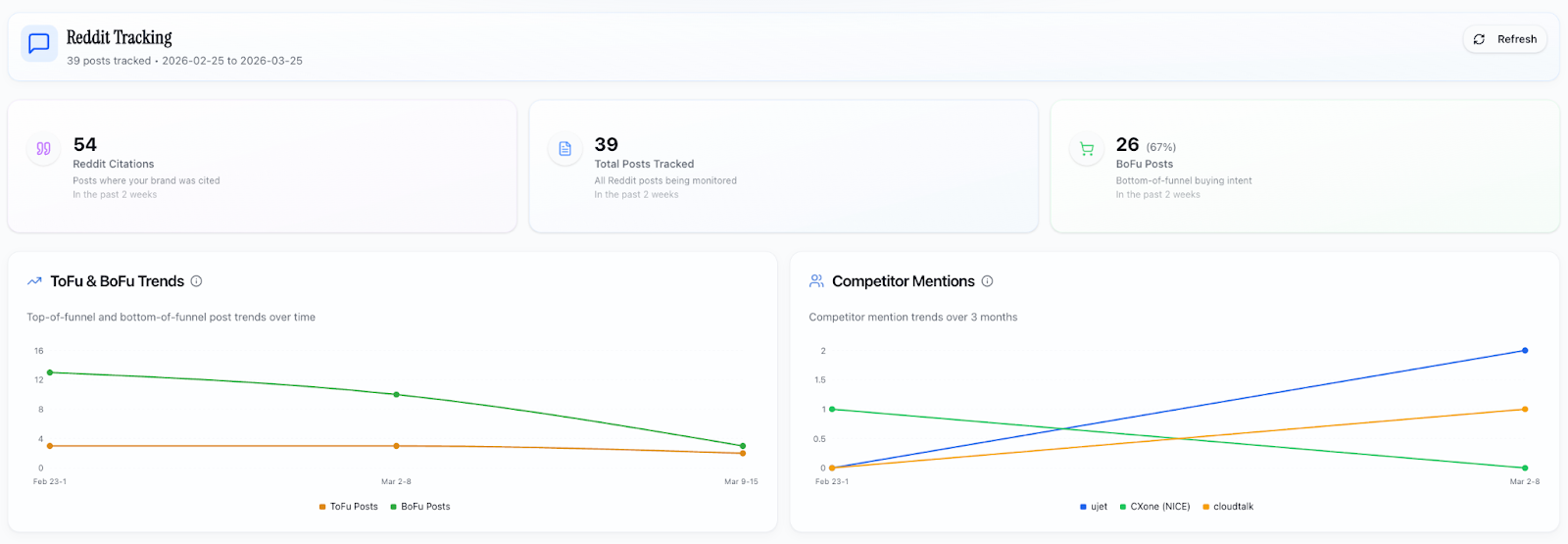
There are three things you can do:
🎯 Action 1: Go through threads that are already being referenced
Go through every thread in your category that is already being cited and make sure you are present in it. This is a one-time activity. Sometimes, these threads may be two or three years old but age does not disqualify them. If an LLM is actively using a post to generate answers today, that post is currently influencing real buyers.
🎯 Action 2: Be present in new threads every week.
In most industries, dozens of high-intent threads start every month. Check for these threads weekly and make sure you are contributing to them.
This gives you a head start in two ways:
- Buyers asking questions on Reddit are often the same buyers asking those questions on ChatGPT. When you answer a Reddit thread, you are potentially showing up in both places.
- The earlier you comment on a thread, the more engagement your comment tends to get. Being one of the first brands to contribute makes it easier for your comment to rise to the top of the thread, which is exactly what LLMs see when they reference it.
🎯 Action 3: Start your own conversations
This is genuinely the hardest part of Reddit. In active industries, new threads appear faster than you can track them. In niche ones, threads are rare and by the time you find them, it is too late to make an impact. And if you engage with the wrong threads, you waste time and risk your Reddit reputation.
Chosenly helps you find the right threads at the right time. But if you do not have the bandwidth to manage Reddit end-to-end, we can connect you with one of our partner agencies who do this for brands in your space.
3E. Positioning
Everything up to this point has been about getting found. Positioning is about getting chosen once you show up.
AI search is not a popularity contest anymore. LLMs do not just pick whoever shows up most often. They find the right information, already have some beliefs, and then use both of these to decide which company is the best fit for the specific criteria in the prompt.
For simpler searches, getting found is usually enough. But for more complex searches, where a buyer adds criteria like budget, team size, or a specific use case, the only way to show up is to objectively prove you are better than your competitors on those specific criteria.
When an LLM recommends a product, it is not just picking whoever shows up most often. It is deciding which company is the best fit for the specific criteria in the prompt.
Understanding the dashboard:
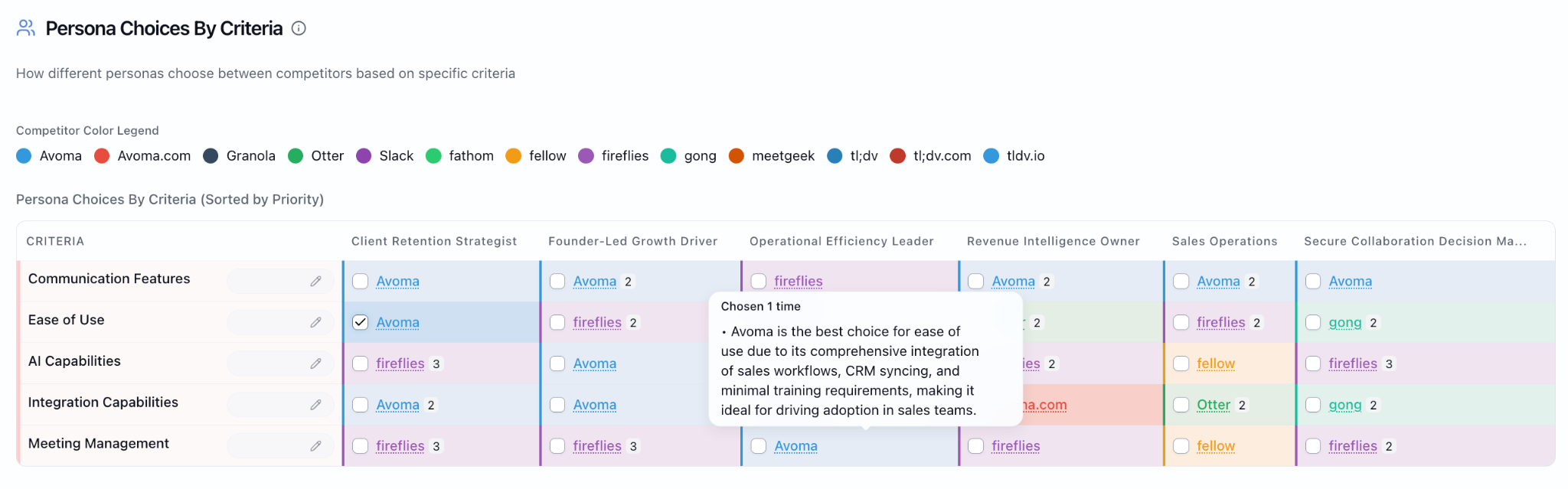
The left column lists the criteria LLMs use to make recommendations in your category — things like Communication Features, Ease of Use, AI Capabilities, Integration Capabilities, Meeting Management. The columns across the top are your buyer personas. Each cell shows which company an LLM recommends most for that combination of persona and criteria. If you hover over a company name, it shows the reason why that company was recommended.
How to move your positioning:
Find the criteria where no company has clearly staked a claim yet. That is your fastest opportunity. Pick the ones where you genuinely have a right to win, write a clear and simple description of why, and make sure that framing shows up everywhere your brand is mentioned.
If you do not see a clear way to win on any criterion, that is also useful information. It may mean you need to niche down rather than compete broadly.
🎯 Action 1: Decide where you have a right to win
Look at the criteria list and the reasons LLMs give for recommending each company. Find the criteria where no one has clearly staked a claim yet or where the current winner does not deserve it.
When we did this for Chosenly, Customer Support came up as a criterion where the competitor being recommended for it had raised $20M. We were bootstrapped and that was the reason LLMs had formed that belief. But it was not a good reason. We give consulting calls with every plan and one-on-one Slack and email support. We had the right to win.
🎯 Action 2: Collective objective proof of why you’re better than your competition for that criteria
Once you know which criteria to go after, collect proof. In Chosenly's case, the objective proof for support was:
- Consulting calls included in every plan
- Dedicated one-on-one Slack support
- Direct email access to the team.
These are not claims. They are facts a buyer can verify.
🎯 Action 3: Add proof to your website
For objective criteria (performance benchmarks, feature availability, accuracy rates), companies that publish concrete, data-backed comparisons tend to win those criteria in AI recommendations.
You can either add this as a dedicated page, a post, or even as part of an existing page.
Eg: In our case, we added this information on a dedicated support page.
(Screenshot or Gif of the page)
🎯 Action 4: Make sure third-party content reflects your positioning
In the Chosenly example, adding it to our website was enough. But in cases where the criteria is more competitive, you may also need 3rd party websites to back your claim.
The more external sources that describe you in the same terms, the more confident LLMs become in recommending you for that criterion.
3F. PR
If you decide to take Action 4 of positioning and need third-party content to back your claims, PR is where that happens.
Here is how to do it:
Chosenly tells you which PR sites are being referenced in your category, so you know which ones to prioritise. Use that to create a simple request sheet for your PR team with three things:
- which PR sites to target for AI search
- which criteria and claims to weave into any existing PR pieces
- what specific language to use so that external sources describe you the way you want LLMs to see you.
Share that with your PR team. They do not need to change their entire program. They just need to know which publications matter for AI search and what paragraph to add.
Very few teams do PR specifically for AI search. And generally you do not need to. Usually, the request sheet is enough to add a flavour of AI search to existing PR activities.
Step 4: Figure Out Who on Your Team Does What
Most teams do not have a dedicated GEO function. The work sits across content, marketing, CS, and sometimes the CXO suite. Before you decide what to focus on, figure out who on your team can actually own each activity because that will shape your plan more than anything else.
- Content typically sits with whoever runs your content or SEO program. Since creating, updating, and repurposing all fall under one team, but bandwidth is limited. It is hard to do all three at the same time, so you will likely need to pick one mode to start with..
- Outreach usually lands with a marketing generalist or the SEO team. Occasionally the outbound team picks it up because they already have the workflow and infrastructure for it. But for most companies it is new work, so it needs a clear owner with real time allocated to it. Without that, it will not happen. Most of our clients opt for our done-for-you model for this.
- Review sites are usually owned by the CS team. Coordinate with the marketing leader of your company so they can convince the PR leader to do this for you. .
- Reddit is the activity most often handed off entirely. When it is kept in-house, the social media team or a marketing generalist usually picks it up. Sometimes the SEO team takes it on.
- Positioning: often involves the CXO suite. Sometimes the marketing team has more control. Either way, you need someone from the marketing team who can push the team that owns this to align on a direction and get approvals.
- PR: If you already have an active PR program, this folds into it. Very often, PR is owned by an agency.
Step 5: Pick three things and execute
Going through this process will reveal more insights than any team can act on at once. The goal of this step is to narrow it down to three things and commit to them.
Answer these three questions to decide:
- Can you get the bandwidth and approvals for it? Some things will never happen no matter how high-impact they are if your team does not have the time or you will never get approvals. Only pick from what can actually get done.
- Does the data show a strong correlation with results? Look at what the companies ahead of you are doing. If the leaders in your category all have significantly higher citation share, outreach has a proven correlation. If their most referenced pages are all recently updated, a content refresh does too. Follow the signal.
- How easy is it to implement? Look at your topic breakdown, how quickly could you create content for those gaps? Look at your citation data, how many of those pages do you think you could realistically get into? Look at your positioning graph, are there criteria where proving you are the best is simple and objective? The easier something is to move on, the faster you see results.
Conclusion
If you are reading this, you already know that showing up in AI search matters and that the companies that figure this out early will be harder to displace later.
But the space is noisy. Everyone has an opinion on what to do, and most of it is too vague to act on. The difference between companies that see results and ones that do not is not effort. It is direction.
Everyone is chasing the latest GEO tip they saw on LinkedIn, adding schema markup, creating LLMs.txt files, and hoping something sticks.
The brands that will win at GEO are not the ones doing the most. They are the ones who looked at their data, understood what is actually driving results in their category, and built a plan around that.
You now have everything you need to do that.
Every month, we build 10 GEO strategies for free. A full audit of where you stand, who's beating you, and exactly what to fix. Confirmation within 24 hours. Strategy delivered in 72 hours.
FAQs
1. What is a GEO strategy?
A GEO strategy is a plan to get your brand recommended by AI tools like ChatGPT, Perplexity, and Gemini when buyers search for solutions in your category. It is not about ranking on Google. It is about making sure your brand shows up in the actual answer an LLM gives.
2. How is a GEO strategy different from an SEO strategy?
SEO gets your pages to rank on Google. In contrast, a GEO plan for a B2B business gets your brand mentioned in AI answers. They use different data, different activities, and measure success differently. SEO looks at rankings and traffic. GEO looks at how often you get recommended and where you appear when you do.
3. What are the five steps to create a GEO strategy?
Here's what a strong GEO strategy usually includes:
- Define your inputs: LLM, region, prompts, competitors, and buyer personas
- Measure your baseline: visibility and rank in AI answers today
- Identify your levers: listicle outreach, content, review sites, Reddit, and positioning
- Map activities to your team: assign owners and check bandwidth
- Pick three priorities and execute
4. Which LLM should I start tracking for GEO?
Start with ChatGPT. It has the largest share of AI search traffic by a wide margin. Trying to track ChatGPT, Perplexity, Claude, and Gemini all at once before you have a working system adds complexity without proportional return. Get results on one first, then expand.
5. How long does GEO take to show results?
Listicle and blog placements can move your visibility in 4 to 8 weeks. Positioning and content changes take longer, usually 2 to 3 months, because LLMs need to see updated information across multiple sources before they change what they recommend.
6. Does SEO help with GEO?
Partially. Good content that performs in SEO can also get referenced by LLMs if it is in-depth, recently updated, and adds unique insight. But standard SEO tactics like backlinks, keyword optimization, and technical fixes do not directly improve GEO. The biggest GEO levers sit mostly outside the traditional SEO playbook.
7. What kind of content do LLMs actually reference?
- In-depth and well structured
- Recently updated
- Rich with data, screenshots, or examples
- Adds a unique insight or perspective not found elsewhere