
Outreach Guide: How to Get Listicle & Citation placements for AI SEO visibility (2026)

A step-by-step guide for B2B marketing teams who want to show up in AI search results by earning placements in the listicles and blog posts that LLMs actually cite.

When a buyer asks ChatGPT "what is the best project management tool for SaaS companies," the answer does not really come from thin air. ChatGPT pulls from a set of source pages when answering searches, and its recommendations are heavily influenced by what those pages say.
Which means, if your product isn't mentioned in them, you're not really going to make the cut.
And by the way, LLMs are trained on internet data, so the pages that get cited today are also shaping the model's foundational understanding of your category. Getting cited isn't just about showing up in answers, it's about being baked into how the model thinks about your space over time.
Now most B2B teams respond to this by creating a lot of new content: blog posts, comparison pages, landing pages optimized for AI search. And sure, that works, but it’s slow.
There's a faster path that most teams overlook: getting your product mentioned in the pages ChatGPT already cites.
Those source pages are usually listicles ("Top 10 CRM Tools for Startups") and in-depth blog posts that compare products in your category. The authors of those pages update them regularly. And they are often open to adding relevant products, especially if you give them a reason to.
That process of identifying the right pages, finding the right contacts, and earning a placement is what we call citation outreach.
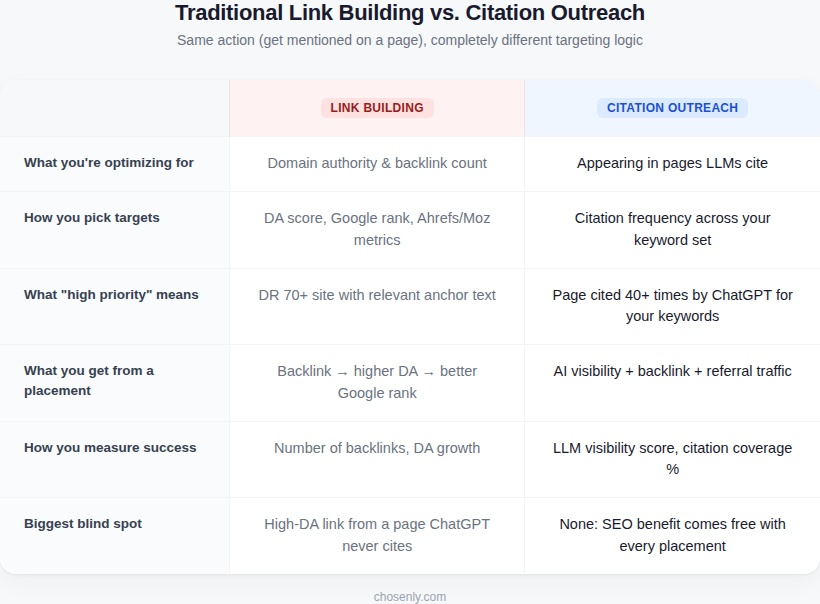
Citation outreach is different from backlinking
This is not traditional link building. You are not chasing domain authority or spam score. You’re targeting the specific URLs that LLMs use as sources when answering buying queries for your product category.
The prioritization is different, the outreach strategy is different, and the ROI model is different. A single placement in a listicle that ChatGPT cites 40 times a month across your keyword set can move your AI search visibility more than a dozen backlinks from sites ChatGPT never looks at.
That said, citation outreach does not only deliver AI search value. Every placement you earn in a listicle or blog post carries three layers of return:
- AI Search/GEO value (the primary reason you are reading this guide) You get added to pages that LLMs already cite, which is the most direct way to increase your visibility in AI search results.
- SEO value. A lot of listicle placements include a backlink to your site, which builds domain authority the same way traditional link building does.
- Referral traffic value. Many of the listicles ChatGPT cites also rank on Google for the same bottom-of-funnel queries you care about. A link from those pages drives qualified traffic regardless of whether the visitor came through ChatGPT or Google.
This triple return is what makes citation outreach one of the highest-leverage activities a B2B marketing team can run right now. And here is how you can do it, step by step.
TL;DR
Here is the full process at a glance. Each step builds on the one before it, starting with finding the right pages and ending with tracking your new placement.
To be honest, the entire process takes hours of manual work across multiple tools, and there's usually nobody on a marketing team who owns it end-to-end. Chosenly automates the entire workflow for you (yes, including the negotiation).
Now let's walk through each step in detail.
Step 0: Know which searches to find citations for
Citation outreach doesn't work for every type of search. Before you start collecting URLs, you need to know which searches actually lead to vendor recommendations. There are three types:
- "Recommend a tool for X" (Bottom-Of-Funnel). These are direct buying searches: "best project management software for SaaS," "top CRM tools for startups," "enterprise LMS platforms." ChatGPT consistently recommends specific vendors here, and the citations are almost always listicles and comparison posts. This is the primary target for outreach.
- "Help me do X" (Job-To-Be-Done). Whether vendors get recommended here depends on the industry. "Help me reduce my AWS bill" will almost always surface SaaS tools because software is the default way to solve that problem. "Help me reduce my Google ad spend" probably won't recommend agencies because ChatGPT will give tactical advice instead. If your product category is the obvious way to accomplish the job, these searches are worth targeting. If it's not, skip them.
- "Alternatives to Y." These searches reliably recommend vendors because the intent is explicitly about comparing products. The citations tend to be listicles and comparison pages, making them strong outreach targets.
ChatGPT can mention vendors in informational and how-to searches too, but those mentions are mostly influenced by educational blog posts where the author specifically talks about their own product (like this one!). Getting placed in someone else's how-to guide where they're showcasing their own tool is often not realistic.
You need a clear list of your target searches across these three types before anything else in this guide applies.
Step 1: Find out what pages ChatGPT cites for your B2B searches
Next thing you need: a list of every URL that ChatGPT uses as a source when answering the BOFU searches you identified in Step 0.
The manual way
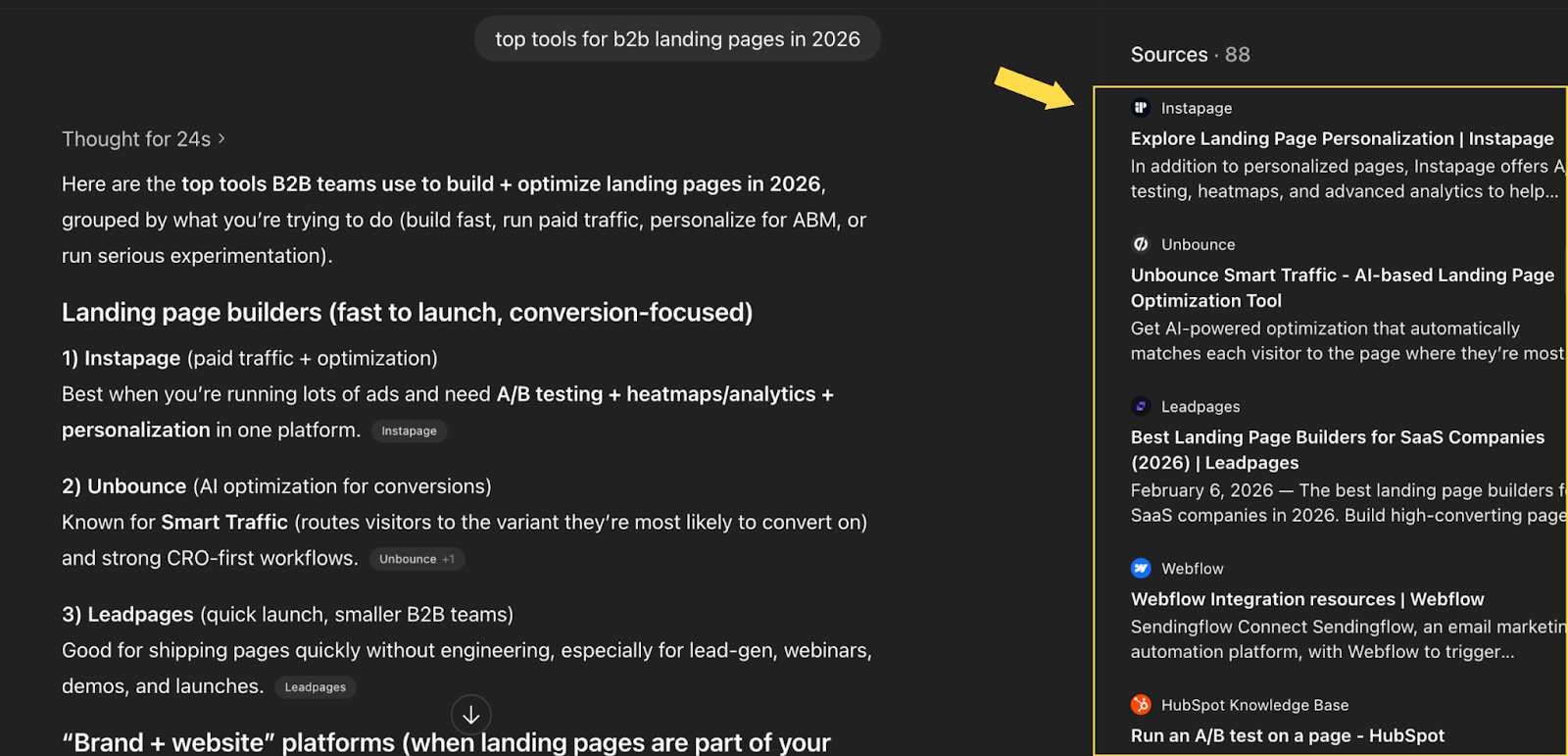
- Open ChatGPT and start a Temporary chat so your chat history doesn't influence the answers.
- Type your search
- Click through the citations on the right side of the answer (Note: some links only show up inline in the answer text, not in the citation list on the right. You can skip those when doing this manually because checking for them across every response takes way too long.)
- Copy each URL into a spreadsheet.
- Repeat for every search on your list.
- This task will take a couple of hours a day for about a week to get into a sheet. So start with just 50 searches initially. Doing more than that delays actually starting the outreach, and honestly, nobody enjoys data entry work this repetitive.
- Important: Once you have all the URLs in one place, create a pivot table so you know how many answers each URL influenced. A page that shows up as a citation across 40 of your searches has a much higher priority than one that appeared once.
This is a great way to get started. But doing it manually has a few obvious drawbacks:
- It’s a very slow process (but you already know this)
- you're only seeing citations from one run per search, which misses the variance in LLM responses (to understand more about this, check out this article)
- you're also spending most of your time on data entry instead of actual outreach
How Chosenly handles this
Chosenly's Outreach Module skips the collection step entirely. Everything is already done for you, the moment you log in.
For every search you track, it compiles every URL that ChatGPT has used as a citation across multiple runs, already sorted by how many answers that URL influenced. A page cited 56 times across your searches will obviously have a higher priority than one cited once. That sort order is what turns hundreds of URLs into a ranked queue you can actually work through.
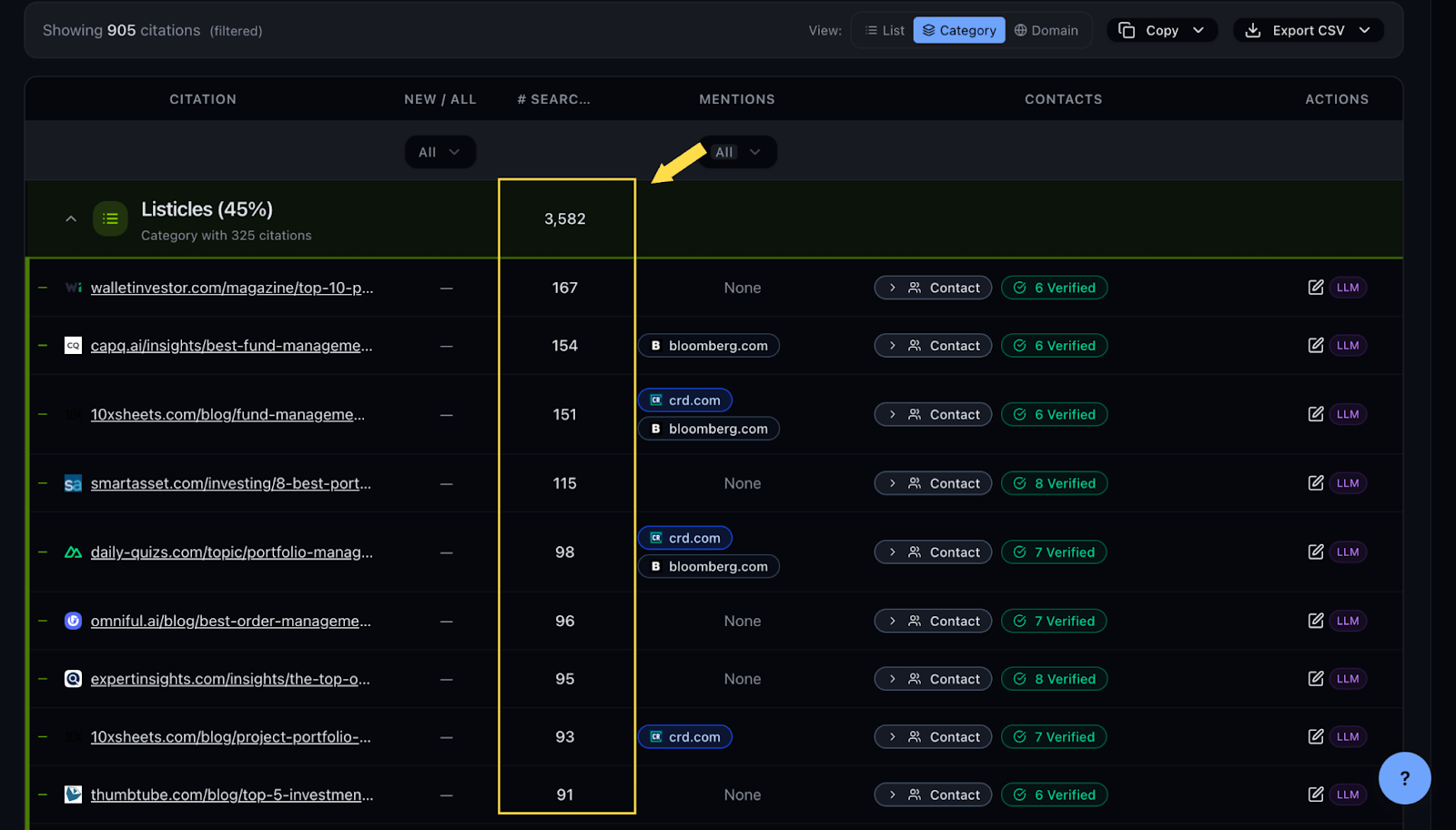
Now that you have the entire list of cited URLs, the next step is to find out which ones are worth going after.
Step 2: Filter for listicles and blogs
By now, you'll have a list that sorts URLs by how many answers they influenced. But not every citation is an outreach target.
ChatGPT cites a lot of pages like listicles, blogs, Wikipedia pages, company landing pages, review aggregators, and press releases.
The only page types worth pursuing are listicles and blogs. These are pages where the author can actually add your product; either as a new entry in a list or a mention in a relevant section.
Landing pages are owned by competitors who will never feature you. PR articles are written once and never updated. Review aggregators have their own submission process. Editing Wikipedia is just an unrealistic task.
So the goal of this step is to go through your ranked list and identify which of your high-priority URLs are listicles or blogs, and ignore everything else.
The manual way:
Starting from the top:
- Open the highest-cited URL from your list
- Look at the page and tag it in your spreadsheet - listicle, blog post, landing page, review site, press release, or other.
- Move to the next URL.
- Keep going until you've categorized enough high-priority URLs to have a workable outreach list.
- Filter your spreadsheet to show only listicles and blogs.
- That's your outreach-ready list.

Pro tip: If you're doing outreach for GEO just as a test, you don't need to do steps 2 (and 3) before you start outreach. You can just do them for a URL at a time as you consider reaching out.
But if you're setting up a more serious program, you'll probably have to do it upfront. Knowing the total number, relevance and types of the URLs, and also the number of people in each company you'll reach out to will let you:
- Estimate the number of reach outs you'll need to do.
- The budget you'll need for the program
- The bandwidth required to pull this off
- The infra (email IDs, LinkedIn profiles) you'll need to do the reach outs
- How long it'll take
- The number of mentions you'll be able to get by the end of it
This is useful to have clarity, and in some cases absolutely necessary to get approvals for the program itself.
How Chosenly handles this:
Chosenly automatically categorizes every citation into types (like listicles, blogs, landing pages, review sites, Wikipedia, PR) so you can filter down to outreach-ready pages without opening a single link. Just like the last step, you can literally skip the manual categorization step completely.
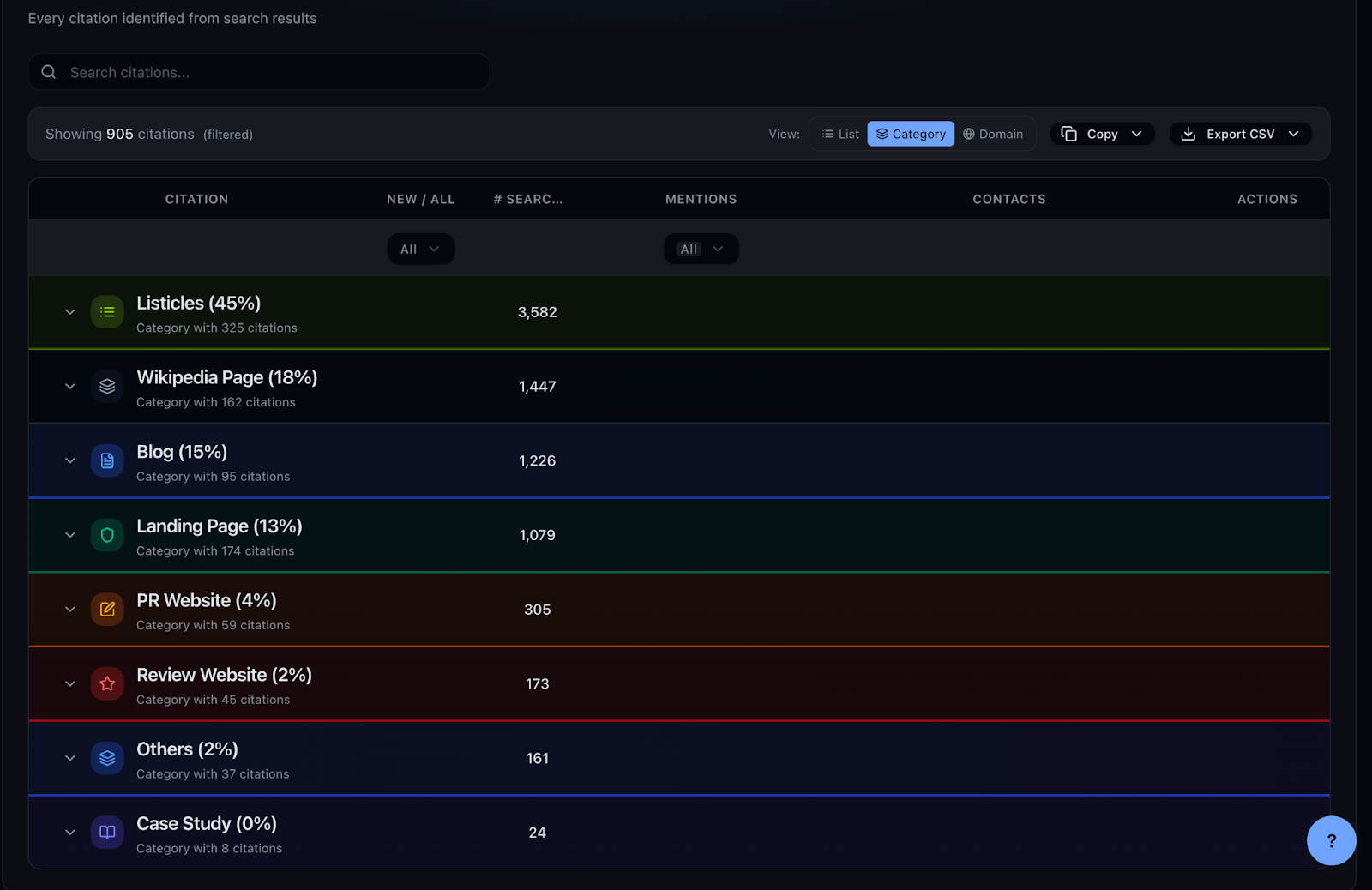
Once filtered, your list should be meaningfully shorter. The next step is to see if we can shorten this list further.
Step 3: Check if ChatGPT is recommending your competitors instead of you
A page can be a listicle about the right topic and still be a bad outreach target. Before you draft a single message, you need to confirm one thing: is this page actually relevant to your product category?
The fastest way to check relevance at scale is to look for competitor mentions. If a listicle titled "Top 10 Marketing Project Management Tools" mentions three of your direct competitors but not you, you know immediately that the page is in your category, the author is aware of your space, and there's an obvious gap where your product should appear. High-confidence target.
If a page mentions zero competitors (or even just one) and the topic is adjacent but not quite right (say, "Best HR Software" when you sell project management), ignore it. ChatGPT sometimes pulls in irrelevant citations that may seem related, and reaching out to these authors wastes both your time and theirs.
Remember competitor mentions aren't the actual criteria here, relevance is. But when you're working through a list of 100+ URLs, checking for competitor names is the quickest way to judge relevance without reading every article end to end.
The manual way
You know the drill by now. We start from our list of URLs again:
- Open every URL and do a manual scan of the page
- Look for competitor names, and make a judgment call on relevance.
- If only one competitor is mentioned, the page is likely not focused on your category and probably isn't worth the outreach. Pages where multiple competitors appear are stronger signals that the listicle is actually about your space.
- Some pages won't fit neatly into one category. The only question that matters is: can the author realistically add my product to this page? If yes, keep it. If not, skip it. Use your best judgement in these cases.
- Repeat these steps for the entire outreach-ready list you had from the previous step.

How Chosenly handles this
Chosenly's Outreach Dashboard shows all competitor mentions directly alongside each URL, so you can see at a glance which pages already mention your competitors but not you, without opening a single link. Pages where multiple competitors appear and you do not are your highest-confidence outreach targets. Pages where no competitors appear are almost always irrelevant, and you can discard them in seconds instead of hours.
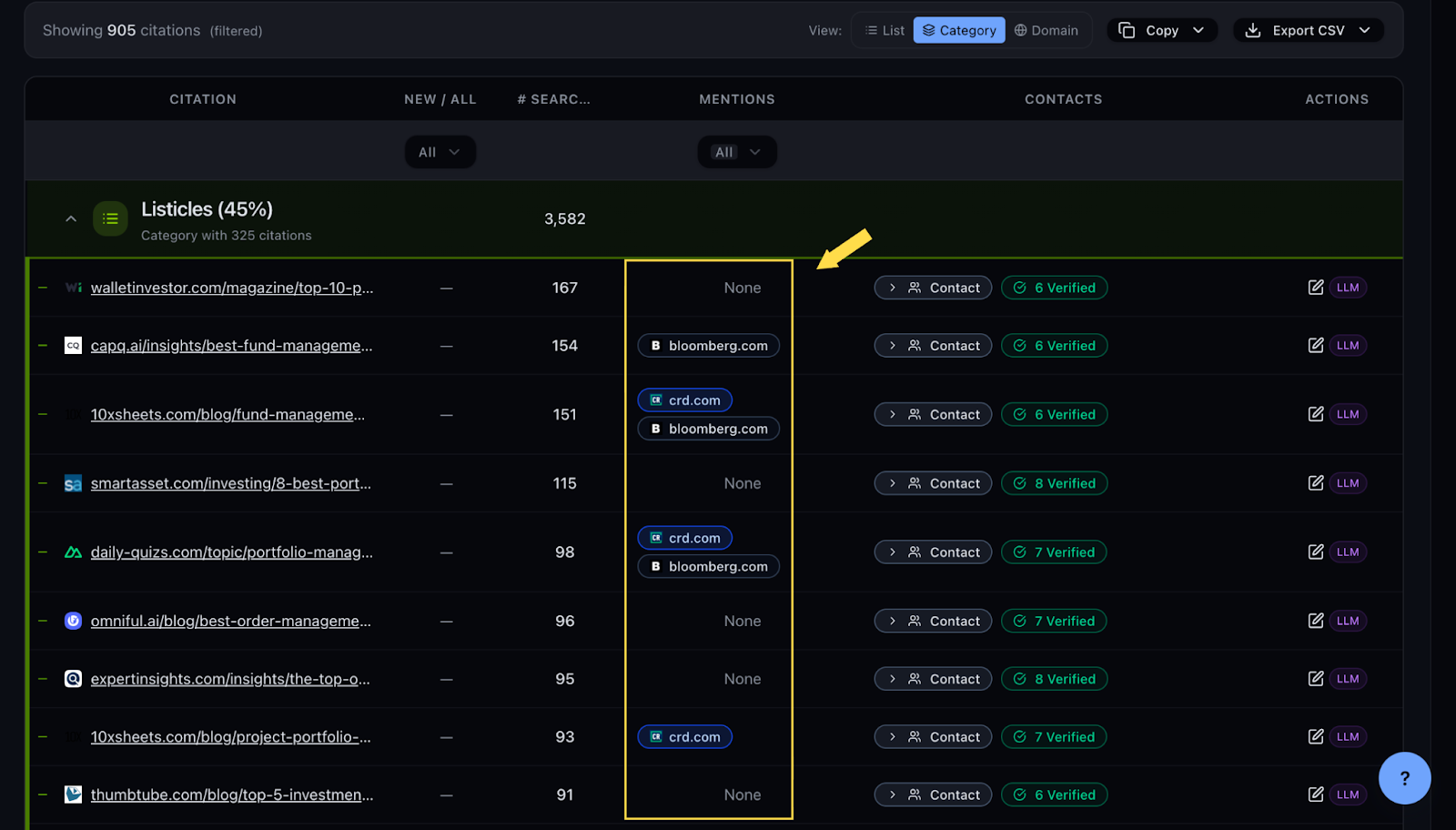
A smaller, validated list means you can put real effort into each outreach message. That matters more than most teams think. When you're working from a large, unfiltered list, the volume forces you into generic automated messages. You end up losing placements from publishers who would have said yes if you'd just taken the time to write something relevant.
Step 4: Figure out who in the company to reach out to
You have a validated list of URLs. Now you need to figure out who from each company (that owns the blog) can actually approve adding your product to their article.
This is where most outreach campaigns go wrong before a single message is sent. Teams default to contacting the author listed on the page.
Sometimes that works. Often it doesn't.
Very often the listed authors aren't really the authors. A writer would have written it, but it would have been attributed to a CXO to make use of their authority/title. Reaching out to the wrong person means your message gets forwarded (best case), ignored (likely case), or lost (worst case).
The manual way
- For each URL, go to the blog's website and try to figure out their team structure.
- Check the "About" or "Team" page.
- Search LinkedIn for people at that company with titles like Content Manager, Head of Content, SEO Manager, VP of Marketing, or Digital Marketing Manager.
- If the company is small, try the founder.
- If it's a larger company, look for whoever manages the specific section your listicle lives in.

This sounds straightforward, but in practice it means hopping between the blog site, LinkedIn, and sometimes Twitter or company directories.
For some blogs, the right person is obvious. For others, you'll spend 10 to 15 minutes just figuring out who to contact, and that's before you've even looked up their email. At a minimum, you need to find at least 3 people per company. If you have a list of 100+ URLs, this research phase alone can take days.
How Chosenly handles this
Chosenly only shows you the most relevant contacts at each publication based on role and title, so you're not guessing or spending time on LinkedIn research. It prioritizes the roles most likely to control listicle and blog updates, not just whoever's name is on the byline.
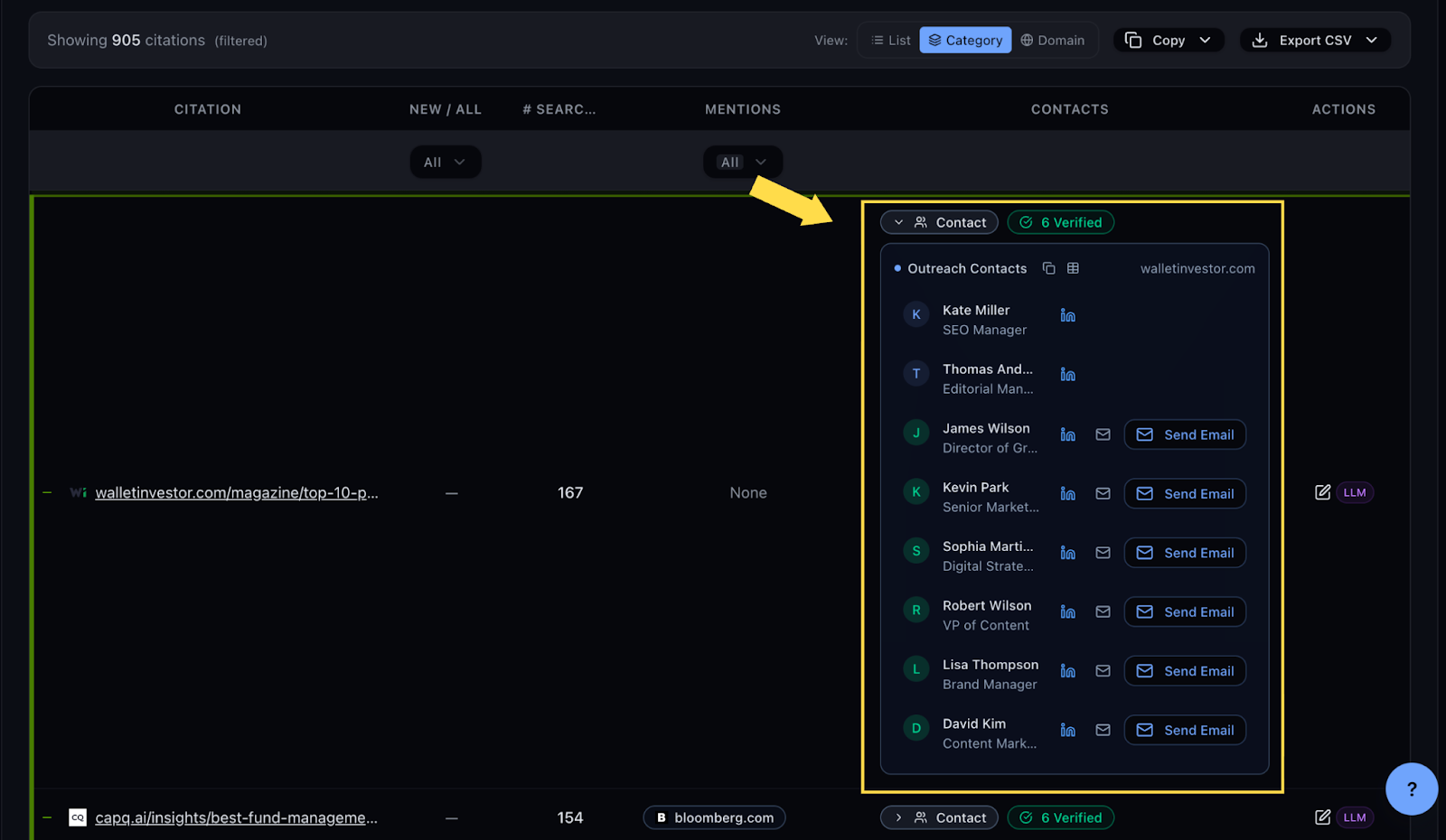
Pro tip: one company may have multiple URLs you want to be a part of, so make sure to take that into consideration when you're doing this research. This is so that you don't waste time repeating the research for the same company when their URL shows up again, and also prioritise which URL you want to make the request for.
Step 5: Find and verify their contact info
Once you know who to reach out to, you need a way to actually reach them. That means a verified email address, a LinkedIn profile, or ideally both.
The manual way
- For each contact, search their name on LinkedIn to confirm they still work at the publication.
- Then use a tool like Apollo or Hunter.io to look up their email.
- Verify the email is active (bounced emails hurt your sender reputation).
- Log everything in your spreadsheet: name, title, company, email, LinkedIn URL, email status.

Here's the part that makes this especially tedious: you won't find data for everyone. Tools like Apollo & Hunter.io sometimes might not have the email.
LinkedIn might show the person but with messaging disabled unless you have a premium account.
So you're hopping between three or four tools, getting partial results, and filling in gaps manually (while really testing your patience).
How Chosenly handles this
Chosenly's Contact Discovery handles this automatically for every URL on your list. It shows you details of contacts - name, title, LinkedIn profile, and email - verified through Apollo's API so you know the address is current
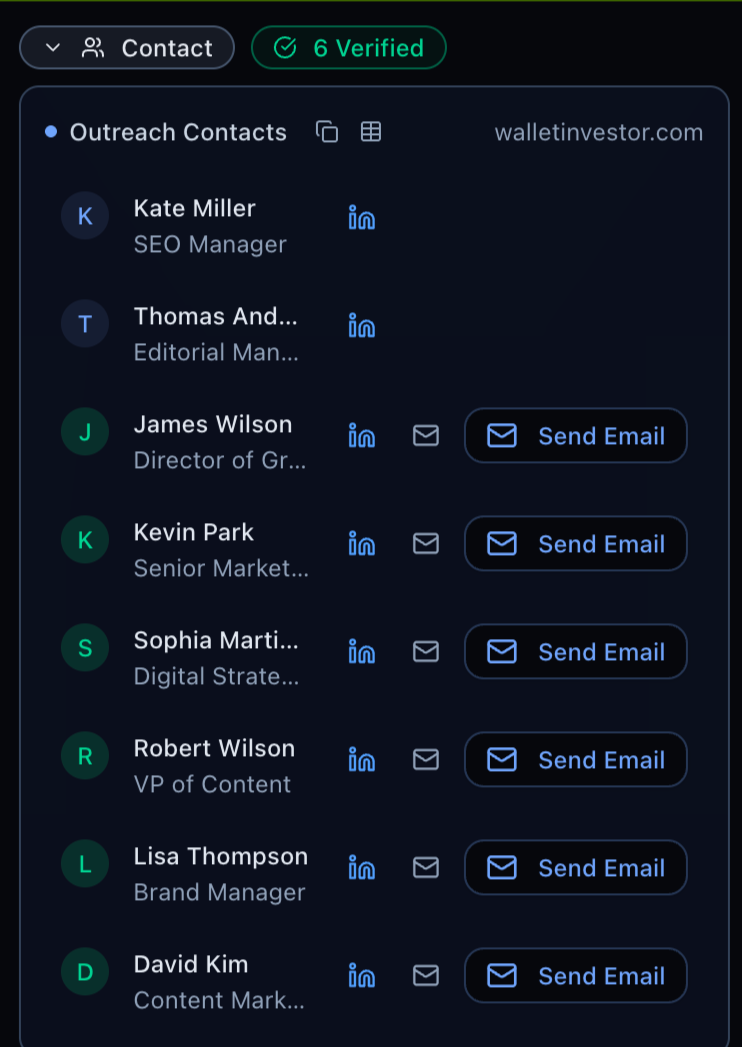
From here, you can either export the data and run outreach yourself, or let Chosenly handle the outreach on your behalf, you would only have to approve the offers and the messaging. You’ll know more on the specific outreach experiments Chosenly runs automatically in the next step.

The difference here isn't just speed. When you do contact discovery manually, you tend to stop at "good enough" because the effort per URL is high. You find one contact per page and move on, even if there were two or three relevant people at that publication, who could have helped you out better.
Step 6: Pick an outreach experiment that gets replies (not a generic cold email)
The single biggest mistake in citation outreach is the generic template.
"Hi, I found your blog very insightful. Would you mind adding us?" gives the recipient nothing to work with. They have to go research your product, figure out if you're relevant, and decide what's in it for them. Most people just don't bother.
And when you consider how much work went into Steps 0 through 5 just to get to this point, losing a placement because your outreach message was lazy is not a good excuse
Instead, lead with a specific offer. Think of each outreach campaign as an experiment with a clear value exchange.
Example play 1: Placement exchange
This works best when your company has its own published listicles or comparison pages. The offer is direct: "We have a page on [topic] that ranks for [search]. We will add your product to our page if you add ours to yours."
When selecting which of your pages to offer, pick ones that are topically relevant to the recipient's product, not just any page you happen to own.
Example play 2: Paid placement
Some publishers expect payment, and the range is wide. Some blogs might accept a $50 Amazon gift card. Those with high domain authority and frequent ChatGPT citations can ask $200 to $500 or more.
The decision depends on how frequently that specific URL appears as a citation and what your client or company is willing to spend per placement.
Chosenly generates a personalized outreach template for each contact that already includes the recipient's name and references the specific blog or listicle where you want the placement. That template is a usable starting point, but you should layer your offer on top of it.
A message that says "Hi Sarah, I noticed your Top 10 LMS Platforms post does not mention us" is better than a generic cold email, but "Hi Sarah, I noticed your Top 10 LMS Platforms post does not mention us, and we have a similar page where we can feature your product in exchange" is what actually gets replies. Use the default template as the skeleton, then customize it with whichever experiment (link exchange, gift card, paid placement) fits that specific target.
Example play 3: Value-first exchange
There's another experiment we've tested at Chosenly for our clients, and it gets significantly higher reply rates.
Instead of opening with an ask, you write a section about the target company, send it to them for feedback and approval, stating that you want to add this to your own listicle (Chosenly's content generation feature auto generates these sections we send in emails).
Once they've approved and the conversation is going, you say: "We were going to place you at position 9, but if you can add us to your listicle too, I'll talk to my manager about moving you higher."
Now you're negotiating from a position where they already have something to gain. The placement exchange feels like an upgrade, not a cold ask. Our placement rates are significantly higher with this approach because the conversation starts with value, not a request.
Run these as parallel experiments to track reply rates and placement rates per approach, to find out what actually works.
Pro tip: If you're running this as an ongoing program, you'll be reaching out to hundreds or thousands of people over email and LinkedIn. If you do this from your company's primary domain, you risk getting it flagged as spam. That means buying new domains, setting up email accounts on them, warming those accounts over a few weeks so they build sender reputation, and only then starting outreach. For LinkedIn, you'll likely need multiple profiles to scale without hitting connection limits, which means setting up that infrastructure too. Budget at least a couple of weeks for setup and a few hundred dollars for domains and tooling. With a Chosenly subscription, all of this infrastructure(warmed domains, pre-built email accounts, scaled LinkedIn outreach) comes ready to go from day one.
Step 7: Send the blurb and close the placement before it goes cold
Once a contact replies with interest, the clock starts. Based on outreach data across multiple B2B accounts, discussions that are not finalized within two to three days tend to go cold. The recipient moves on, forgets, or deprioritizes.
Here is what closing a placement actually looks like:
- Prepare your blurb before you get a reply: At the start of any outreach campaign, have a pre-written product description that includes key features, a short value proposition, and any specific data points (customer count, results, integrations) that make the product credible in a listicle context. Ask your product marketing team or client to review this once, so you are not scrambling to write copy after someone says yes.
- Match the existing format: When the publisher agrees to add you, look at how other products are described on their page. If every entry has a one-sentence summary, two bullet points, and a link, send exactly that. If entries are three paragraphs with a screenshot, match that too. Sending a 500-word description for a page that uses 50-word summaries signals that you did not read their content.
- Handle the negotiation: The two most common asks from publishers are a reciprocal placement (you mention them on your site) or a fee. For placement exchange, confirm which specific page you will add them to, make the addition within the agreed timeline, and send proof. For paid placements, agree on price, method of payment, and timeline upfront.
- Verify the placement is live: Once the publisher confirms the update is done, check the page yourself. Confirm your product name appears, any links point to the correct URL, and the description is accurate. Occasionally, a publisher will add the mention but forget the link, or slightly alter the copy. A quick check catches this before you move on.
- Track every placement: Record the URL, date placed, type of deal (exchange, paid, gift card), cost, and the keyword set the citation supports. This data is what lets you calculate the cost per placement and eventually tie outreach activity back to LLM visibility improvements.
If you do not want to run this process manually, Chosenly's automated listicle placements feature handles the outreach end-to-end. It identifies priority targets, sends outreach on your behalf using pre-warmed email domains, negotiates with publishers, and only surfaces decisions that need your approval: "May we pay $300 for position 3 in this listicle? Are we okay adding them to this article on our blog in exchange for getting placed in that listing on their blog?"
The system is built on 12+ months of running placements manually for B2B clients, so the templates, sequencing, and negotiation logic reflect what actually converts, not what sounds good in theory. For teams where outreach planning never goes further than a Notion doc because nobody wants to own the process, this is where it gets practical.
Step 8: Fulfill your end of the deal
This sounds obvious. It is obvious. And it's the step most teams skip or delay, which is exactly why we're calling it out.
If you promised a placement exchange, actually publish the article or add the mention to your page. If you said you'd move them higher in your listicle, do it and send them proof. If you agreed to a paid placement, process the payment on time.
Broken promises can destroy relationships. One bad experience and you've made future outreach harder for your entire company.
Step 9: Check back after 4 weeks to make sure the mention is still there
Publishers restructure content. They update listicles and sometimes remove entries. They redesign their sites and old pages break. A placement you earned in February can quietly disappear by April without anyone telling you.
This is the step that separates teams who build lasting AI search visibility from teams who wonder why their numbers dipped after an initial spike.
The manual way
- Set a recurring reminder to revisit every URL where you've earned a placement.
- Open the page, check that the link still works.
- Confirm your mention is still there.
- Keep repeating this step for every placement you earn.
- Set up reminders for each placement, so that you won’t miss checking any.
How Chosenly handles this
Chosenly automatically monitors every URL where you've been placed and flags if your mention disappears or a link breaks. You don't need to check manually or maintain a separate tracking sheet, you’ll have it all in one place.
When a placement drops and you need to re-contact the publisher, having that history in one place instead of scattered across email threads & spreadsheets makes the follow-up conversation much easier.
What most B2B teams get wrong about AI Search outreach
- They send outreach without knowing which pages ChatGPT actually cites: Running outreach based on a Google search for "best [category] tools" and targeting the top 10 results misses the point. Google's ranking and ChatGPT's citation behavior overlap but are not the same. ChatGPT may cite a page that ranks lower on Google if that page has the kind of structured, comparative content that LLMs prefer. Tools like Chosenly that surface the actual citations LLMs use, ranked by frequency, let you prioritize based on AI search data first. The SEO and referral traffic benefits still come with every placement, but the targeting is what changes.
- They do not have content ready when someone says yes: The fastest way to lose a placement is to reply "great, I will send you the details soon" and then take a week to write a product blurb. Publishers who agree to add you are giving you a window, not an open-ended commitment. Have your blurb, formatted to common listicle templates, ready before you start outreach.
- They give up after one round: Citation outreach is not a one-time project. LLMs update their source preferences as the web changes. New listicles get published, old ones get updated, and citation patterns shift. Running outreach as a recurring monthly process, not a quarterly campaign, is what compounds AI search visibility over time.
- Nobody on the team wants to own it: This is the unglamorous truth about citation outreach. Everyone agrees it should happen. The data shows it works. And then the task sits in a project management tool for weeks because it involves repetitive research, cold messaging, and negotiation that no one on a content or growth team signed up for. The teams that actually get results either assign a dedicated person to run outreach as an ongoing process, use a service that handles it for them, or choose a tool like Chosenly that takes care of everything end-to-end.
- They treat it like link building: Traditional link building optimizes for domain authority and backlink counts. Citation outreach optimizes for appearing in the specific pages LLMs use as sources. A backlink from a high-DA site that ChatGPT never cites still helps your SEO, but it does nothing for your AI search visibility. A mention in a mid-DA listicle that ChatGPT pulls from 40 times a month moves both. The difference lies in what’s more important: citation frequency should drive your target list, and the SEO benefit follows naturally.
Conclusion
That's the full process. If you want to test the waters and try it manually, follow Steps 1 through 7 and see what you can close on your own.
If you're serious about making this a repeatable channel, get a Chosenly dashboard. You'll see your citation data & contact list, on day one. We'll walk you through the plan, you’ll know what to expect, the outreach infrastructure will be ready, and placements can start immediately.
Book a demo and see for yourself.
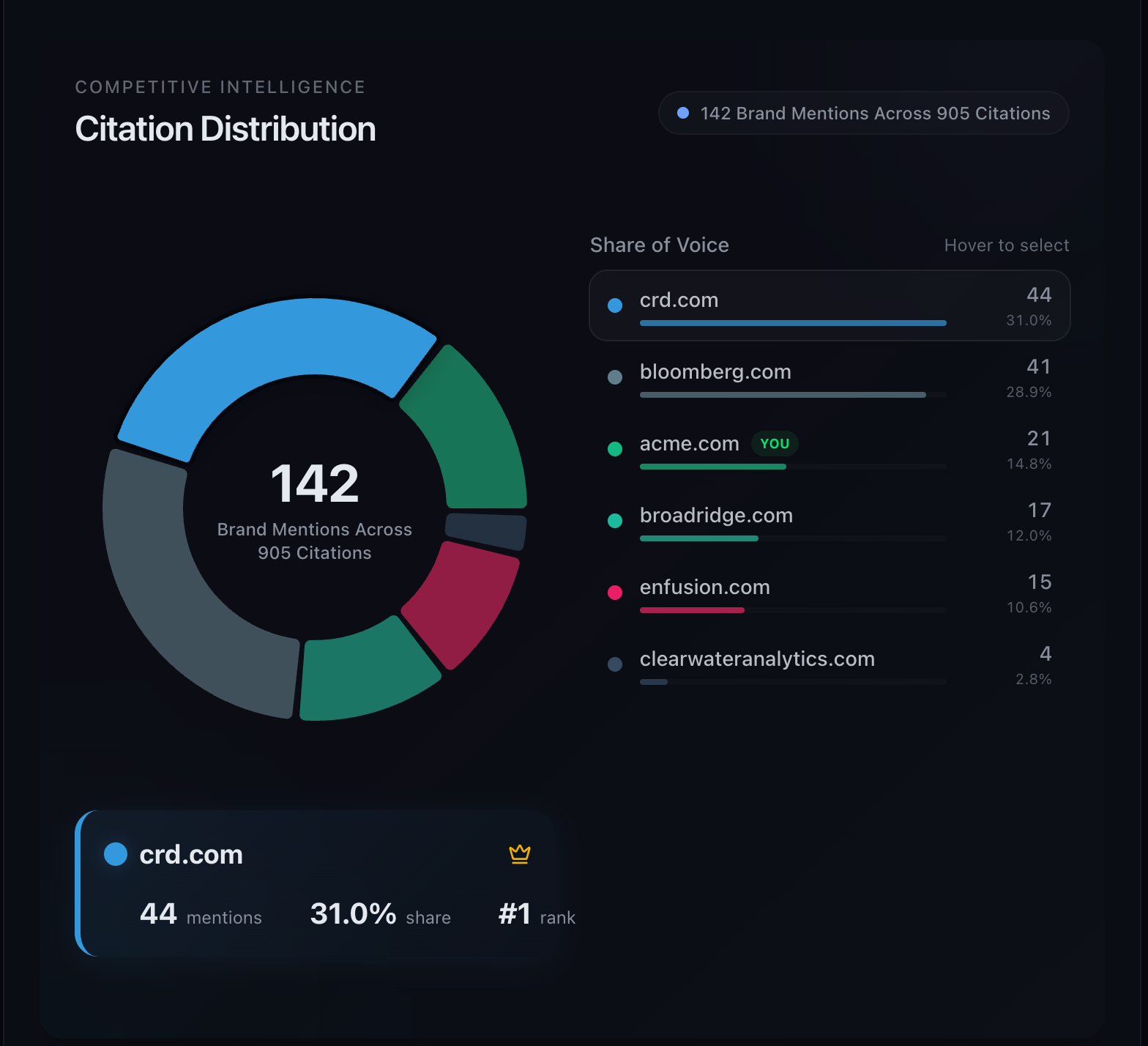
Chosenly's Citation Distribution view showing how 905 citations are split across competitors, with the main brand's share of voice at 14.8%
FAQs About Getting Mentioned in ChatGPT and AI Search
What is citation outreach and how is it different from link building for SEO?
Citation outreach is the process of getting your product mentioned in the specific web pages that LLMs like ChatGPT use as sources when answering buying queries. Traditional link building focuses on earning backlinks to increase domain authority and improve Google rankings. Citation outreach focuses on appearing in the pages LLMs actually cite, which may or may not correlate with high domain authority. The prioritization is based on how frequently a page appears as a citation across your target searches, not on DA scores.
How do I find out which pages ChatGPT cites for my searches?
You can do this manually by searching each keyword in ChatGPT and copying the cited URLs from the response. For a small search/prompt set (5 to 10 queries), this takes an hour or two. For larger sets (50-200 searches), tools like Chosenly compile every citation URL automatically and sort them by how often each page is cited, turning days of manual collection into a ranked list you can filter in minutes.
How do I know if ChatGPT is recommending my competitors over me?
Search your most important prompts (those with high buying intent) in ChatGPT and look at both the response text and the cited source pages. If competitors appear in the answer and you do not, the issue could be that either the LLMs do not have enough information about your product, or maybe the pages they cite do not mention you (there could be many other reasons too). Chosenly's citation outreach module shows competitor mentions per URL, so you can see exactly which pages mention your competitors but not you, without checking each one manually.
How much does it cost to get placed in a listicle ChatGPT cites?
It varies widely. More often than not it’s free. Or we just need to add them to any of our listicles in exchange. Sometimes companies may accept a $50 gift card. Mid-tier publications typically charge $200 to $300 per placement. High-authority sites with heavy LLM citation frequency can ask $500 to $1,000 or more.
How long does it take to improve LLM visibility after getting new placements?
There is no fixed timeline, because LLMs re-crawl sources on their own schedule. However, most teams running consistent citation outreach (at least 5 to 10 placements per month) see measurable changes in their AI search visibility scores within 4 to 8 weeks. The effect compounds: each new mention in a frequently cited page increases the probability that LLMs surface your brand across related queries.
Should I focus outreach on listicles or blog posts to show up in AI search?
Prioritize listicles. In B2B categories, listicles (e.g., "Top 10 Project Management Tools for SaaS") make up the majority of actionable citations. They have a natural structure for adding new products, and authors expect to update them periodically. Blog posts are worth targeting when they are evergreen comparison or resource guides, but one-off opinion pieces or news articles are rarely updated and rarely accept new mentions.
Can I do citation outreach manually without a dedicated tool?
Yes, but the manual process is significantly slower. You would need to search each keyword in ChatGPT individually, copy every citation URL, categorize each page type, check for competitor mentions, find author contacts through LinkedIn and email lookup tools like Apollo or Hunter, and verify email addresses. For 50+ searches this can take 20 to 30 hours of manual work. Tools like Chosenly compress the identification and contact discovery steps, so you spend your time on actual outreach instead of data collection.
What is the difference between AI search optimization and traditional SEO?
Traditional SEO optimizes for Google's ranking algorithm, which weighs factors like backlinks, page speed, and keyword density. AI search optimization (sometimes called GEO or AISO) optimizes for whether LLMs recommend your product when buyers ask questions. The signals are different: LLMs favor structured, comparative content and pull from pages they deem authoritative on a topic, regardless of Google rank. A page can rank first on Google and never be cited by ChatGPT, and a page that ranks on page two of Google can be a top LLM citation.
This article was written with inputs from the Chosenly team. Chosenly is an AI Search Optimization (AISO) platform that helps B2B companies show up in LLM answers. Book a demo to find out more.