
Best Semrush One Alternative for B2B | Pricing, Reviews, Funding and More
Semrush is the tool most of us in this industry grew up on. Here's our honest review of its new AI visibility toolkit, content, and PR features.

My verdict before we deep dive into Semrush One AI review
I've been doing research, analysis, writing comparison pages for over a decade, and by now I usually know roughly where I'll land on a tool before I've typed a word. So before I opened Semrush One, I already had a version in my head: the AI search features are probably fine, everything else is fine, and if you want it all in one place you buy Semrush; if you want a dedicated AEO tool that actually runs the strategy and the work, you buy something like Chosenly.
That is not where I ended up.
I'll be straight with you, because this part is hard to write: I love Semrush. I've used it my whole career. So this isn't a competitor taking shots at a rival. It's someone who's been in this product's corner for years telling you that, as of today, its AI offering is a waste of time. Let’s deep dive into what I found, feature by feature, and I'll come back at the end to what I'd do instead.
How to pick the right AI search tool:
Semrush One vs Chosenly
There are seven things that decide whether an AI search tool is worth paying for. I tested Semrush One AI and Chosenly against each one.
1. What does setup and TTV look like?
Setup and time to value are the gap between paying for a tool and getting your first real answer out of it.
Semrush
- Semrush One trial onboarding itself is quick and self-serve. I was in in no time and looking at the AI visibility dashboard within minutes. The whole approach is built for speed.
- Once I was in, the dashboard threw a lot of data at me, and somehow, even with all of it on screen, none of it told me what to actually do next. Everything sits scattered across separate toolkits: content in one place, outreach in another, the numbers somewhere else. I spent most of my time just working out what my real data was and what's the insight that i should take from this data.
Chosenly
I entered your URL and Chosenly auto-suggests your ICP. You can import your buyer personas or add them manually, and the same goes for competitors and keywords. Connect GSC and you can pull in competitor keywords too.
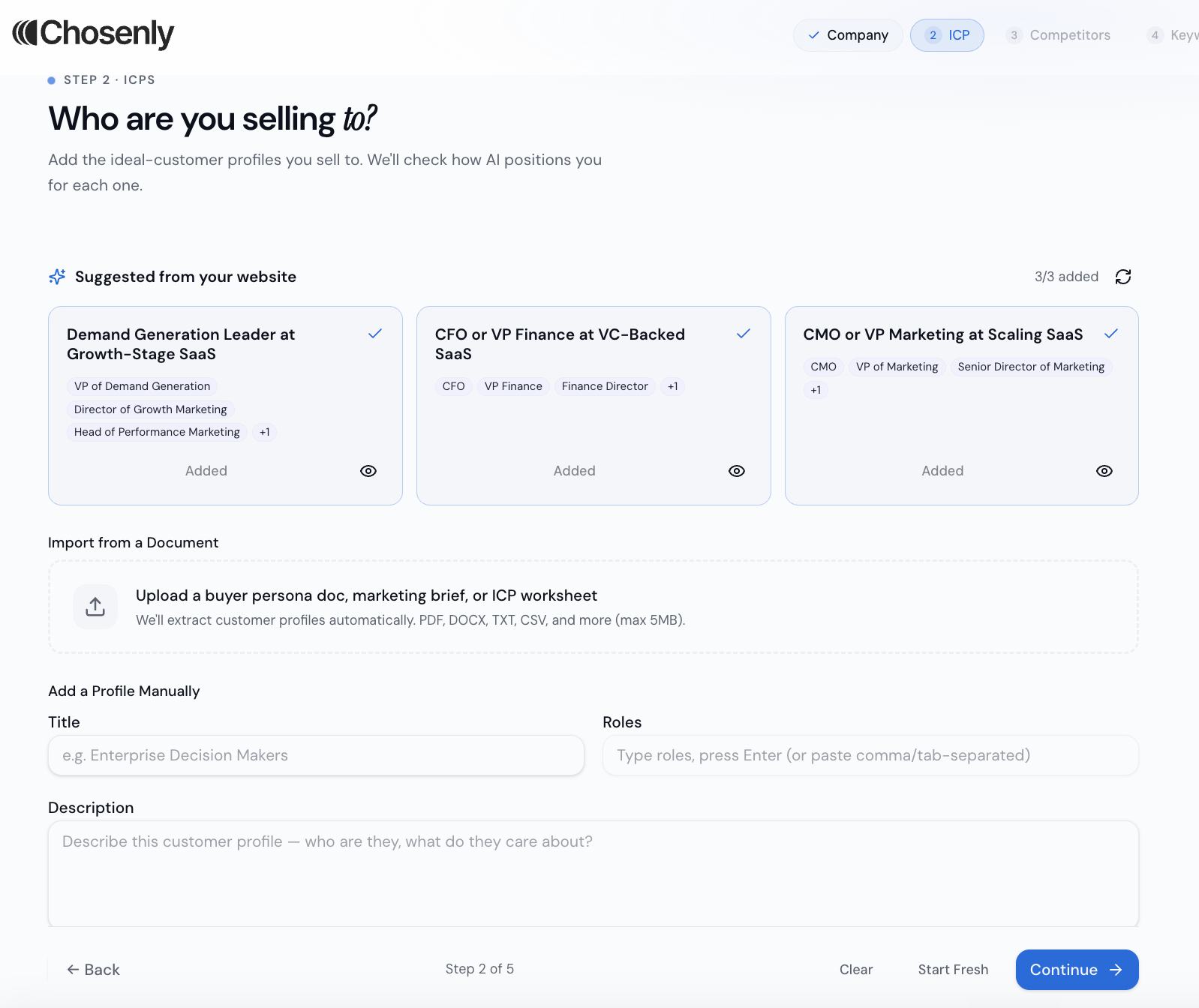
- The same process applies for competitors and keywords. You can also connect the platform with GSC and add competitor keywords as well.
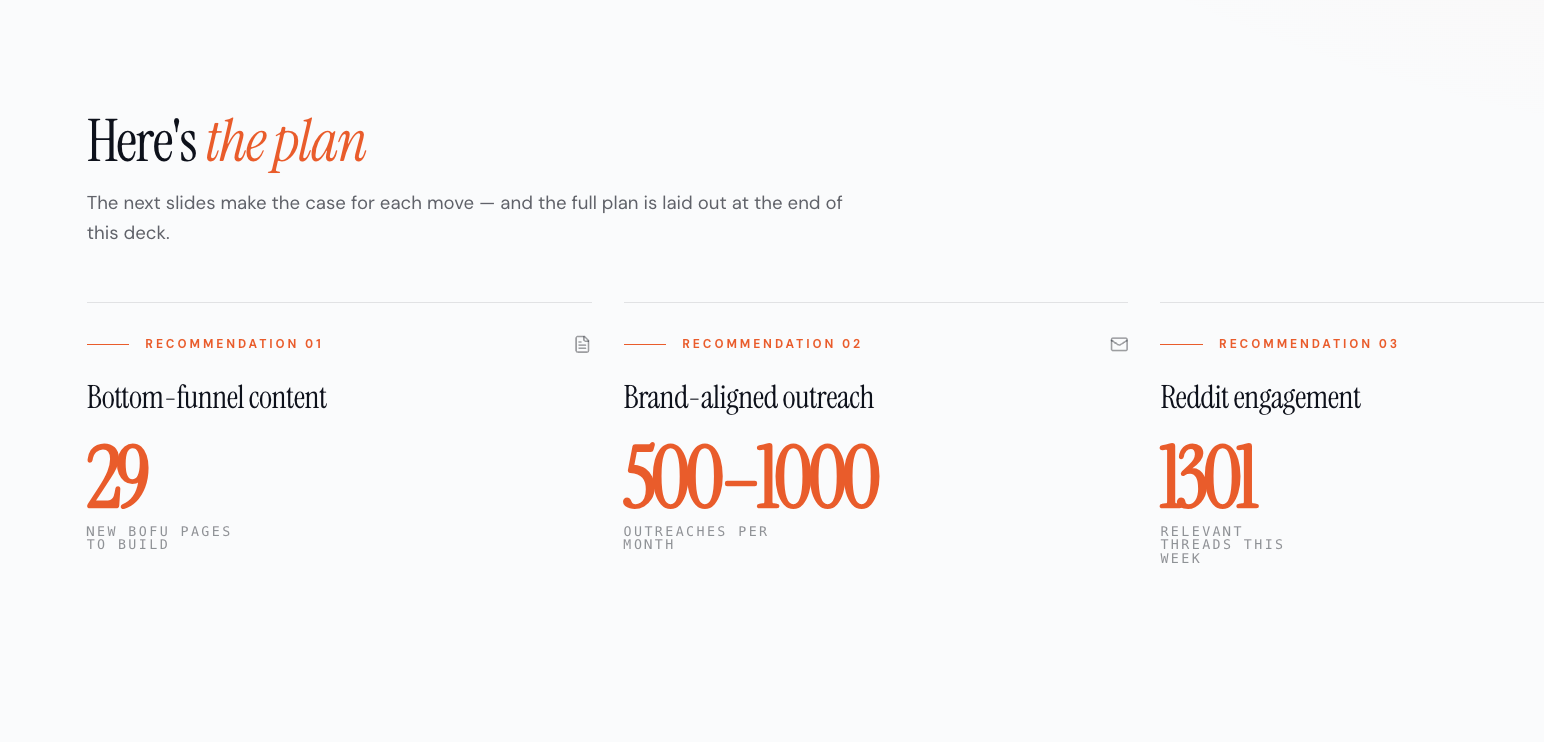
- With Chosenly, the time to actionable insight is quick. The second you sign in, your audit is ready: where you stand, how you benchmark against competitors, and a full strategy with the plan and action items to help you move fast and win in AI search.
2. How reliable is the data the tool shows you?
Before you trust anything a tool tells you, you have to trust two things behind it: the prompts it tracks, and the numbers it attaches to them. If either is shaky, everything downstream is shaky too.
Semrush
- Semrush keyword database holds about 27.9 billion keywords. Their AI prompt library holds 289 million. So the AI side is working from roughly 1% of what the SEO side has. Now, I can't tell you exactly how they built that prompt library, and I won't pretend to. But it's worth asking what a library that size likely prioritizes. If it leans toward the highest-volume terms, that's a problem for B2B, where your best keywords tend to be niche, long-tail, purchase-intent phrases without much search volume, the kind that a volume-first approach tends to skip.
- I tested this on three of our B2B partner agencies and very few prompts I wanted to track were even there. When I seeded something as specific as "SaaS SEO agency", the prompts it handed back were generic. I got "SaaS SEO software" and "what tools are best for SaaS SEO optimization". I didn't want to create content against a single one, because writing about “software” wont make sense and our partner agency would never get cited for that particular prompt.
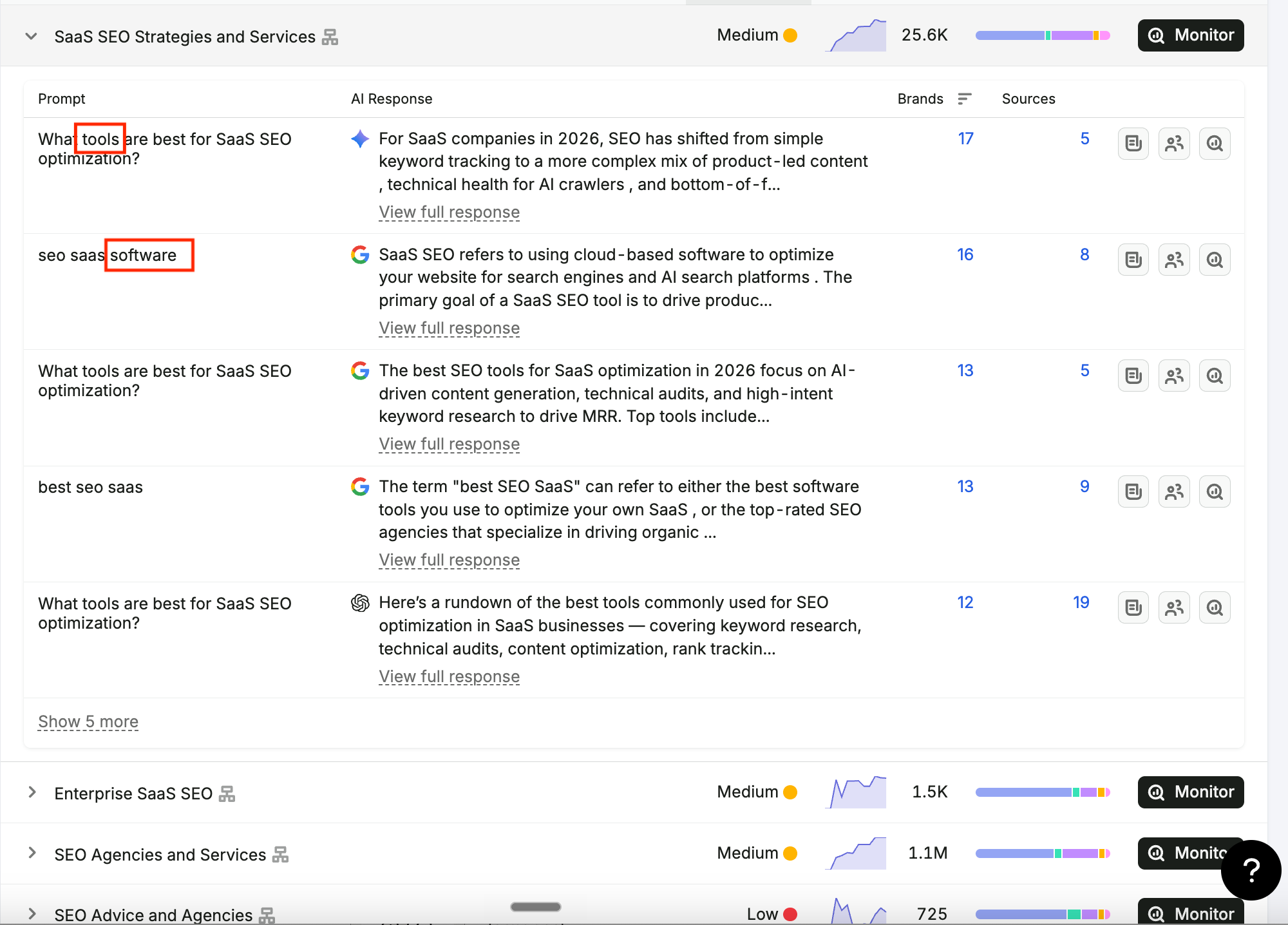
- One more thing I don't fully trust here is the search volumes. Semrush's numbers have never matched what I actually see in GSC, they're usually off. That was already true for regular SEO. With AI search it's shakier still, because there's even less real search data underneath these numbers. So the volume figure sitting next to a prompt isn't something I'd bet a content plan on.
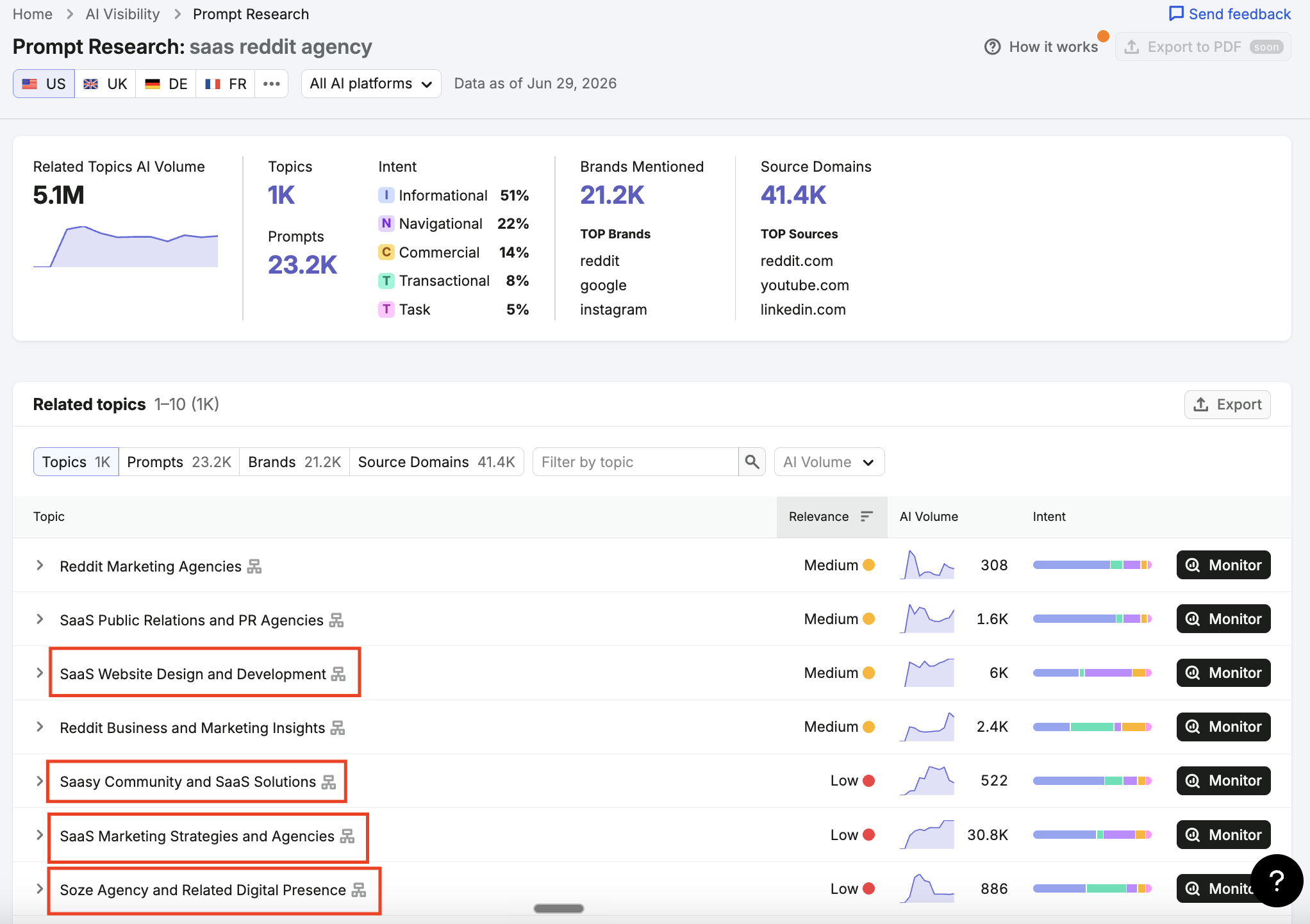
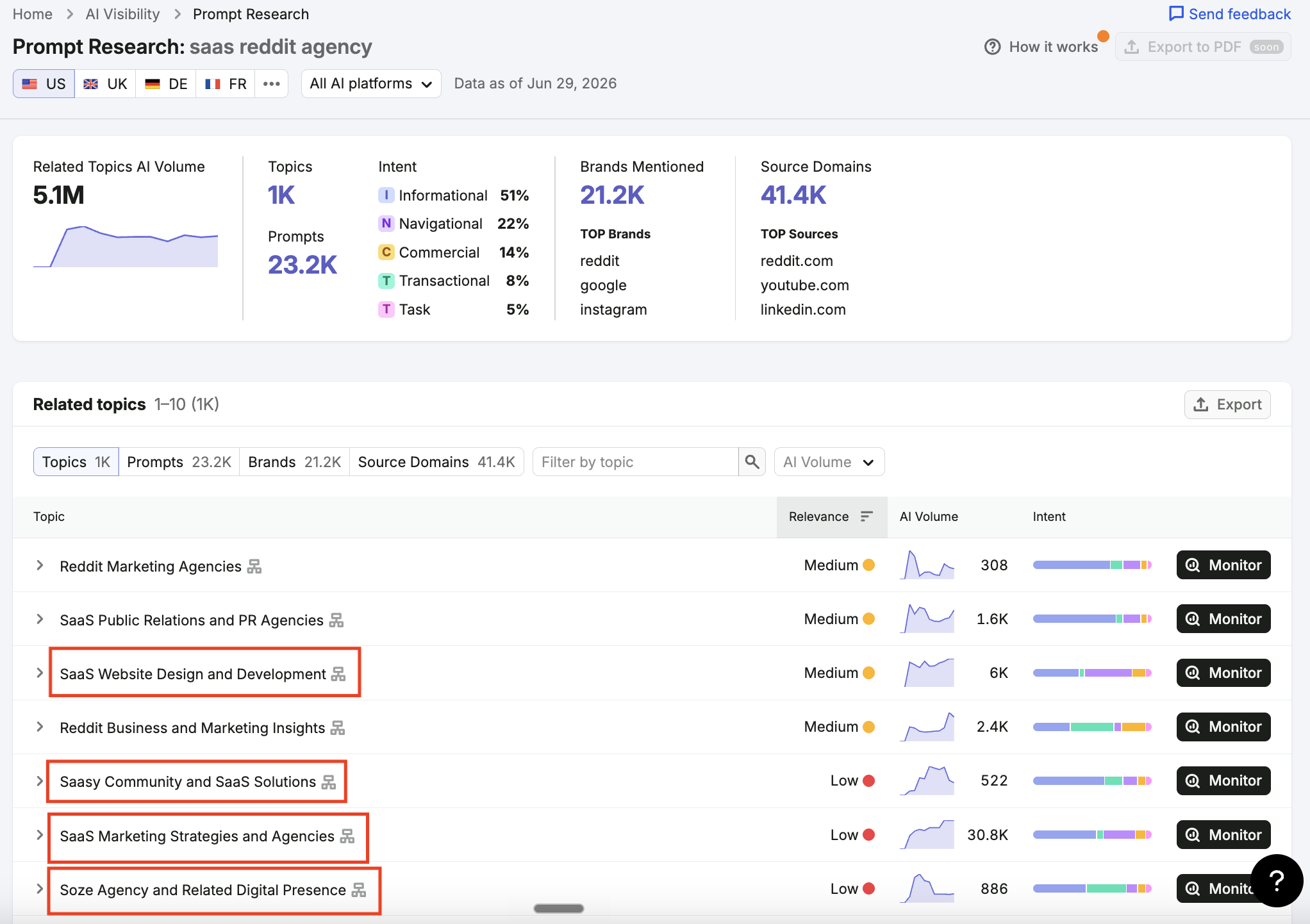
- In the prompt research tab, whatever you type in, the topics that come back are off. I put in "SaaS Reddit Agency" and got prompts about SaaS websites and other things that weren't even related.
Chosenly
- Chosenly runs your prompts in real time. That's the whole difference between partial coverage and full coverage. If a prompt matters to you, Chosenly searches for it real-time, so you always have 100% coverage on your own prompts.
- It tracks the two things every purchase-intent prompt has in common, your seed keywords and your buyer criteria, so the visibility score reflects how you do on the real question a buyer is asking, not just the phrasings you happened to type at setup.
- Prompts that could never return a vendor recommendation get filtered out on their own, so they aren't sitting there moving your visibility score for no reason.
3. What is the breadth of GEO strategies covered
Showing up in AI search takes more than one strategy. You need content, PR, third-party content, Reddit, and more, and a tool worth paying for should cover enough of them that you're not stuck buying three others to fill the gaps.
Semrush
- Semrush covers real ground here. On the GEO side it does content creation, PR, content optimization, and content repurposing. On top of that it has ads and SEO.
I couldn’t find “outreach” though, which is one of the key strategies for showing up in AI search results.
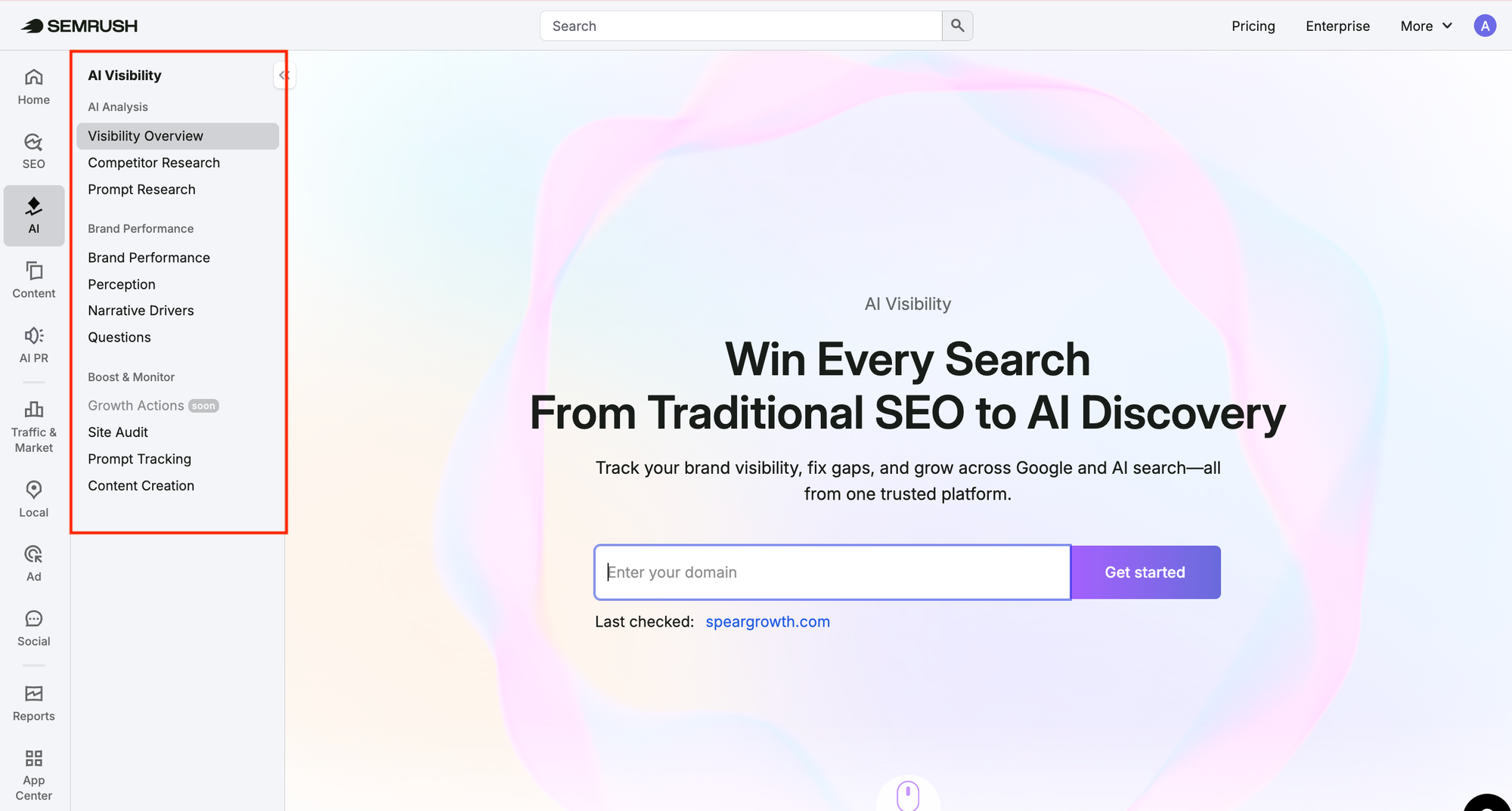
- It also supports PR and it’s genuine strength is finding contacts. It's better than most GEO tools at surfacing the authors and journalists to reach, backed by a large database of who to contact. Though when I showed it to my friend that does PR, he felt it wasn't as powerful as dedicated PR tools and he'd just use them instead.
Chosenly
- Chosenly puts everything into the GEO levers themselves: content creation, content updates, content repurposing, listicle outreach, Reddit, PR, and positioning. Semrush reaches wider into ads and SEO, but on the AI-search side specifically, Chosenly covers levers it doesn't, like Reddit, listicle placements, and positioning.
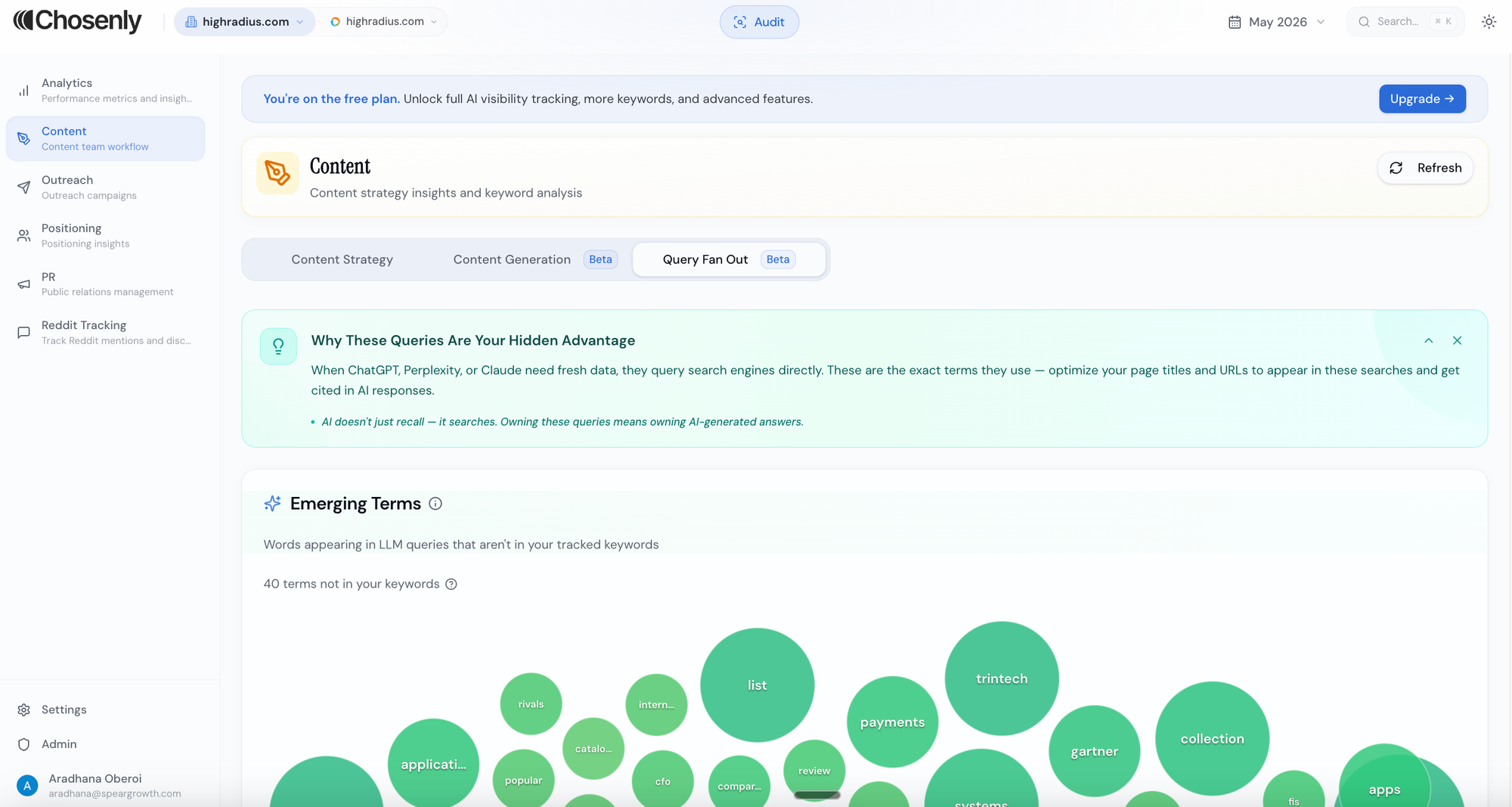
- On PR, Chosenly points you at the right targets: which PR sites to go after. The briefs you build from its data are strong enough to actually help with AI search, and usable as they are.
4. How well do the different modules work together?
Breadth only pays off if the pieces connect. A real suite should feed one module into the next, not hand you a set of tools that each start from scratch.
Semrush
- The modules don't talk to each other. Each one runs separately, so even inside a single project you re-add your inputs and set everything up again every time you move from one toolkit to the next. I typed in the same competitors so many times I started to think Semrush just enjoyed watching me suffer 🙃
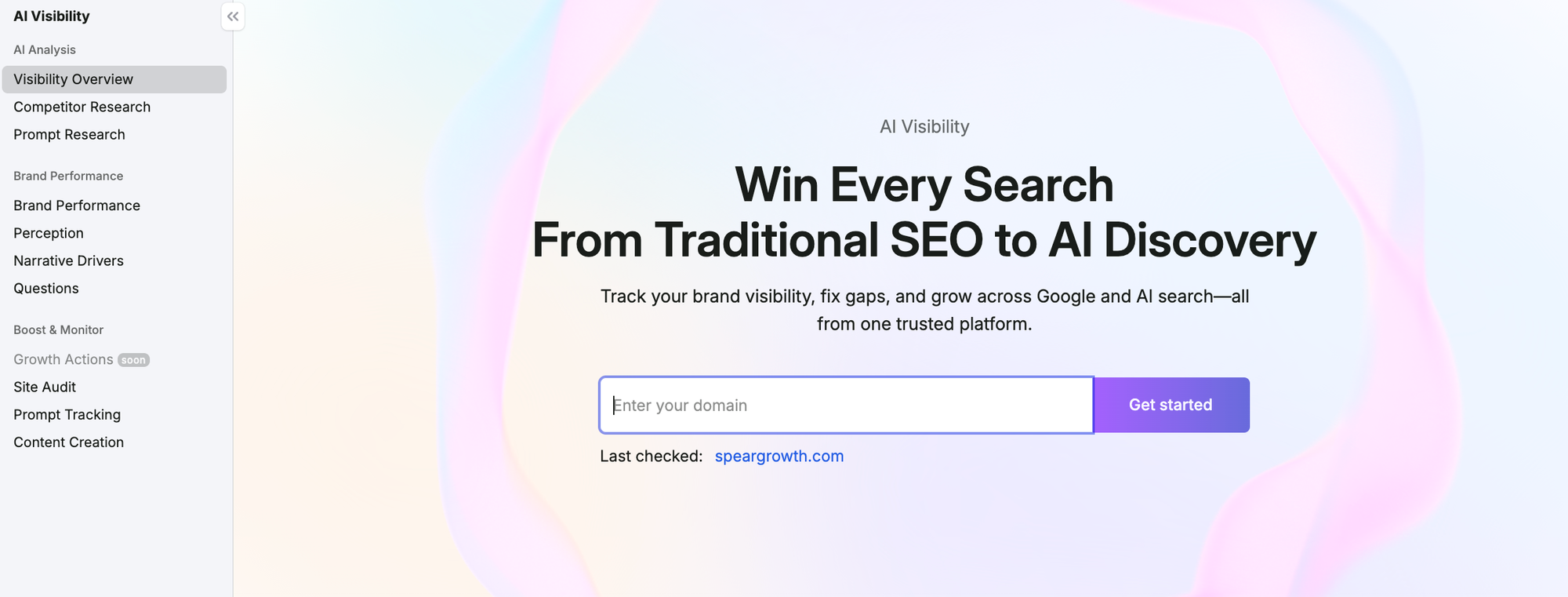
Because nothing is shared, you can't build one strategy across channels. I wanted to plan SEO and AI search together, and that turned out to be near impossible. The ads, SEO, PR, and AI search tools all exist, but they sit side by side instead of feeding into a single plan. Call me whatever, but I don't have the patience to feed in the same info every time.
Chosenly
- Every module reads from the same data. What the citation tracker finds, the content module already knows; what outreach targets, the visibility data already flagged. So you set up once, never re-enter your competitors to move between tools, and never miss the connection between what you're tracking and what you should do next, which is what lets the whole thing run as one strategy instead of separate tools.
5. Does the tool help you prioritize the work?
Finding things to do is easy. The harder job is being told which of them matters, so you're not the one manually sorting a long list into an order.
Semrush
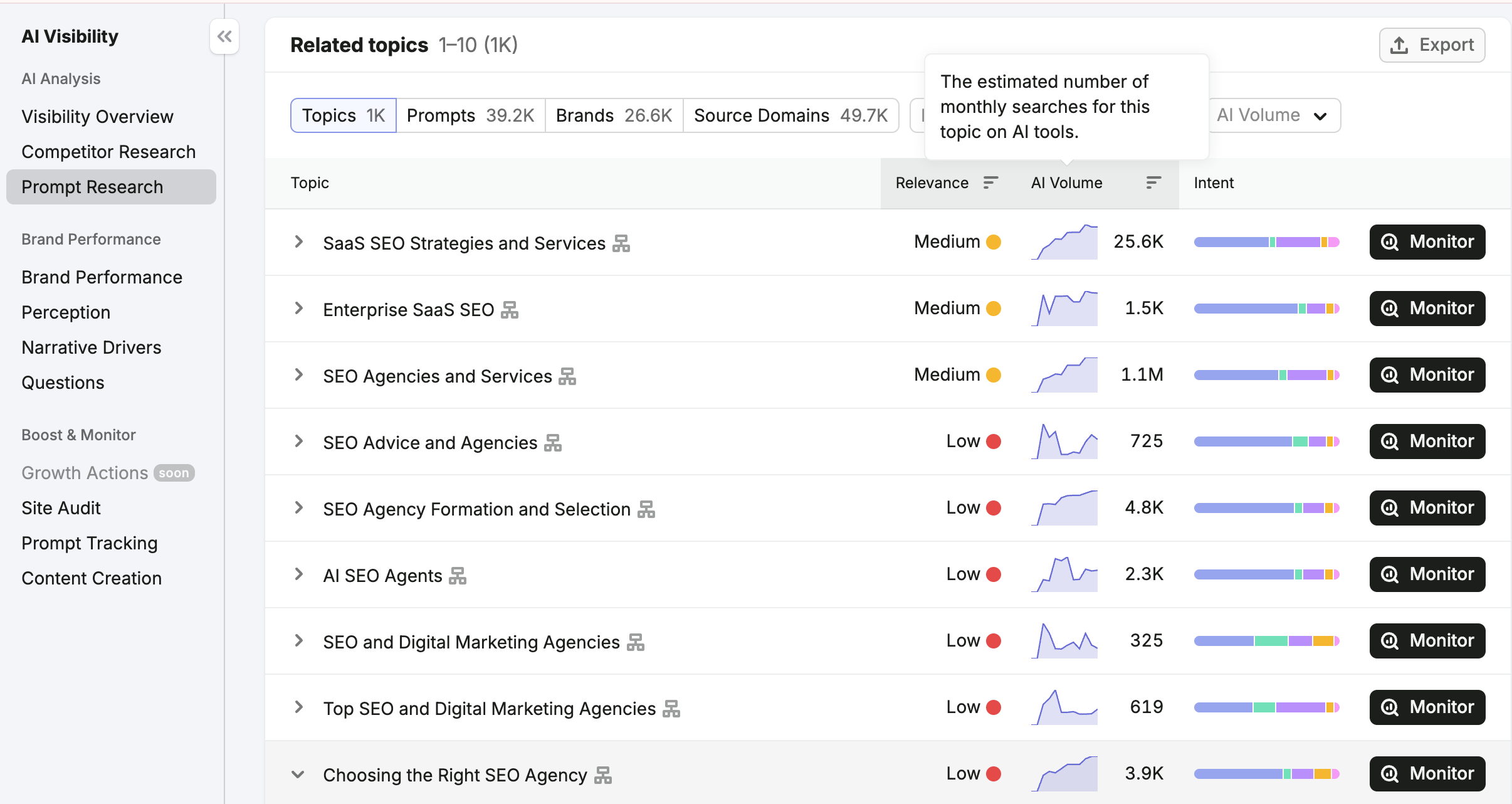
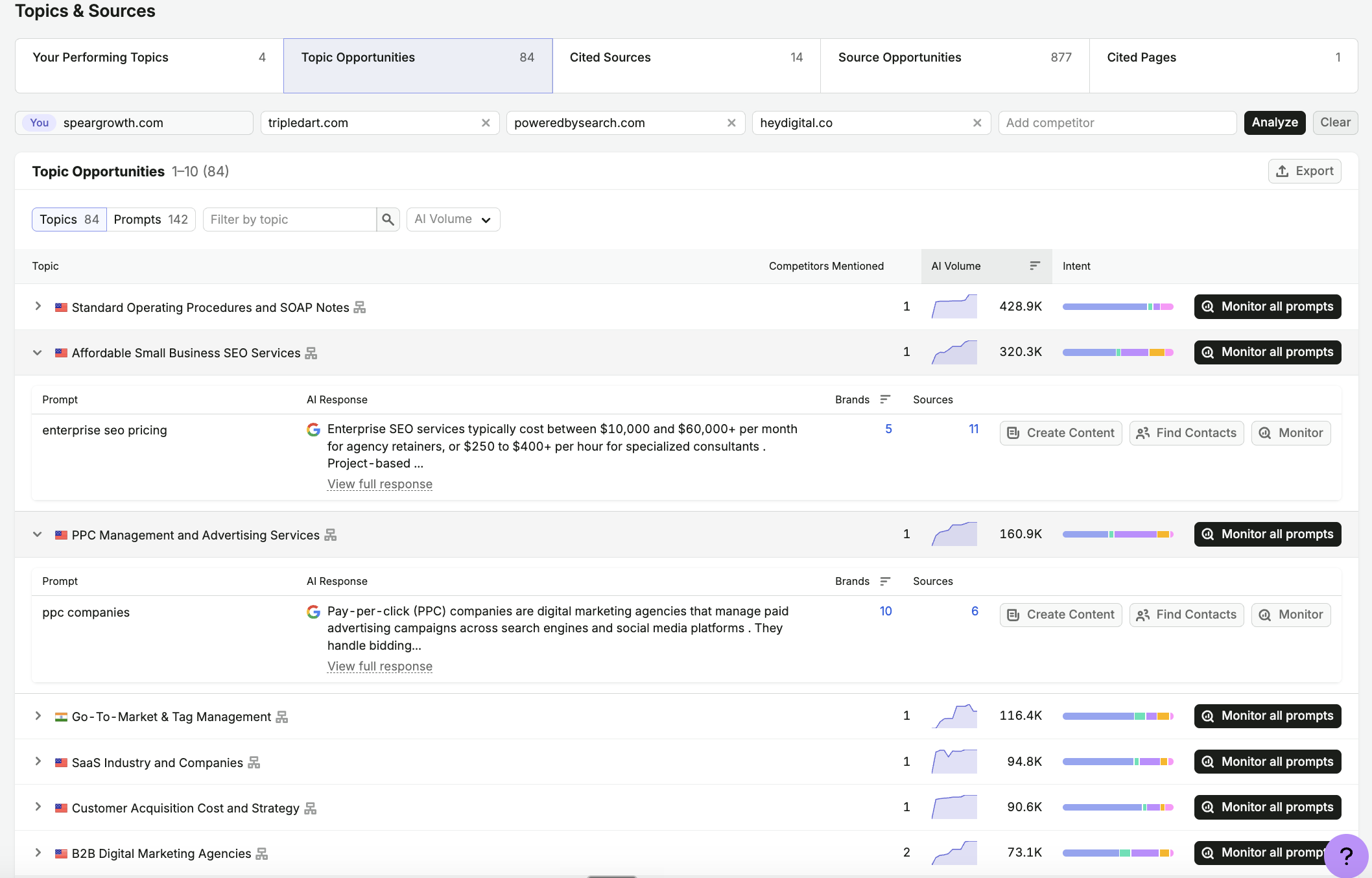
- The way I thought I’d prioritize here is AI Volume. I sorted by it, highest first, and those are the topics Semrush is telling you to work on before the rest. But when I actually sorted by it, the topics at the top were "Standard Operating Procedures and SOAP Notes" and "Affordable Small Business SEO Services". Neither is anything our partner agency would ever go after. So I'm sitting there with a confidently ordered list and no idea what to actually begin with, because the topics are too generic to tell.
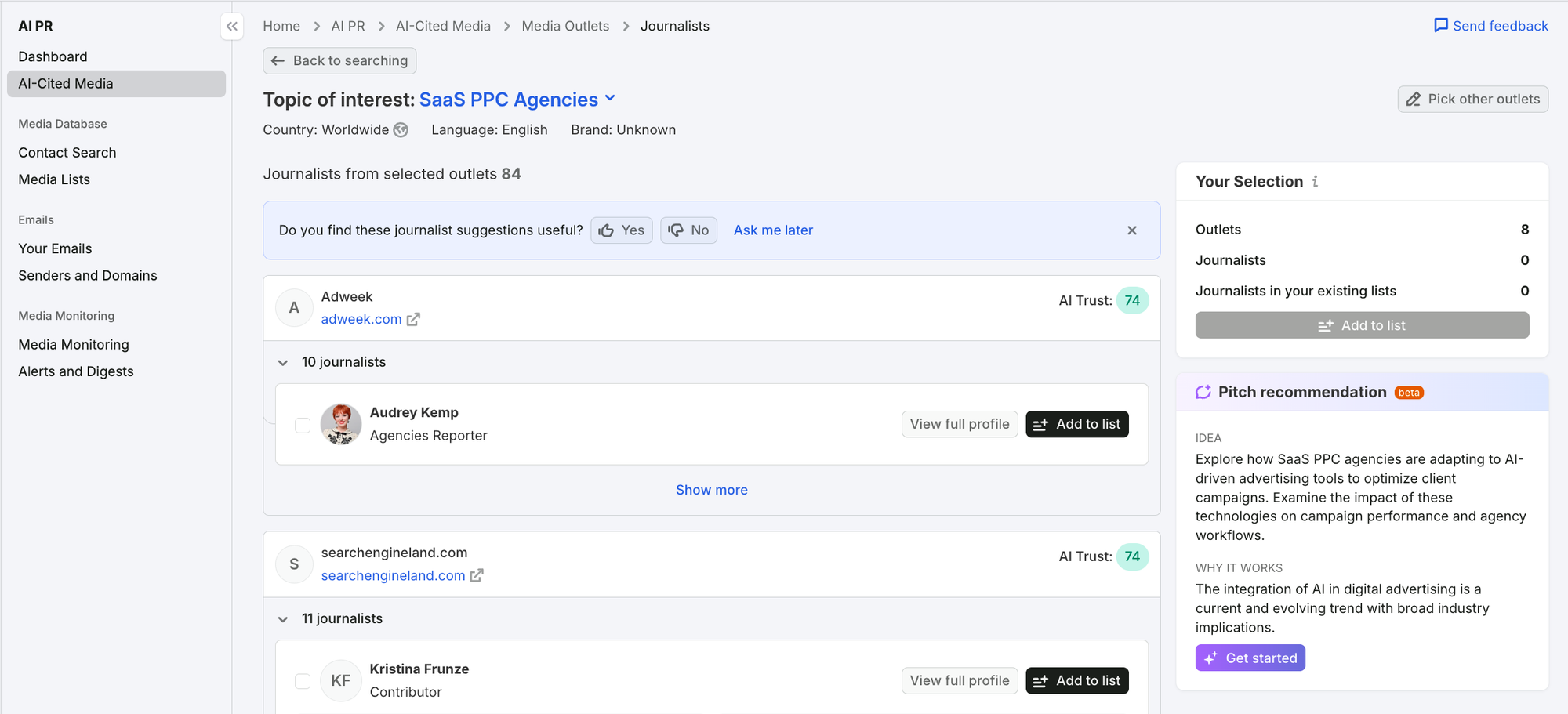
- I hit the same wall on PR. It found me plenty of contacts, but nothing told me who to prioritize or why I'd reach one person over another. And when I looked at the pitch it drafted for me, it wasn't good enough to send.
Chosenly
- Instead of a volume number sitting on a generic topic, Chosenly gave me three strategies to start with, ranked by what would move my visibility most from where I actually was.
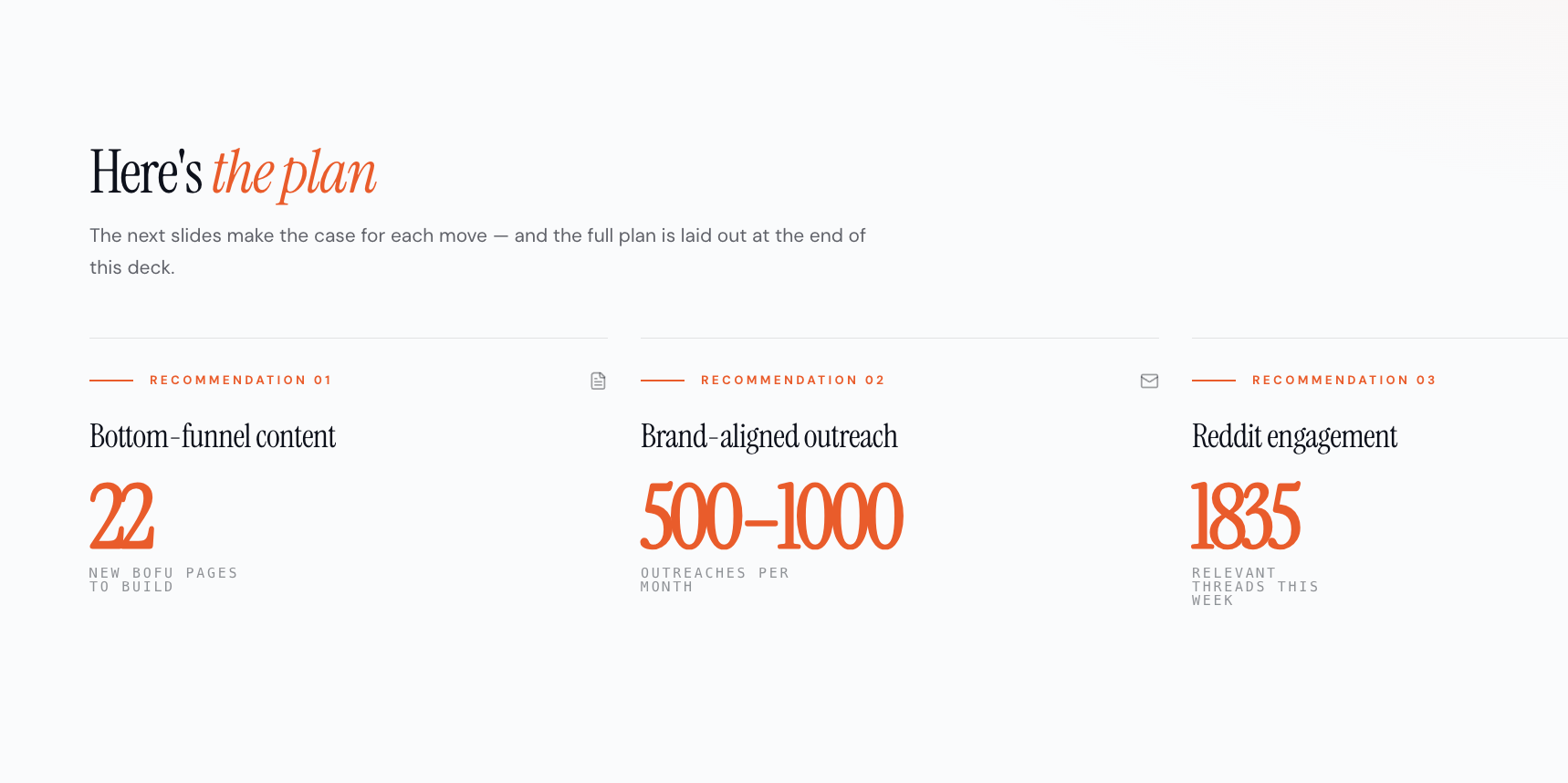
- When the same gap showed up across several LLMs, it came through as one recommendation, not the same task repeated for every engine.
- Every recommendation shows the data behind it, so I could see the why behind every recommendation.
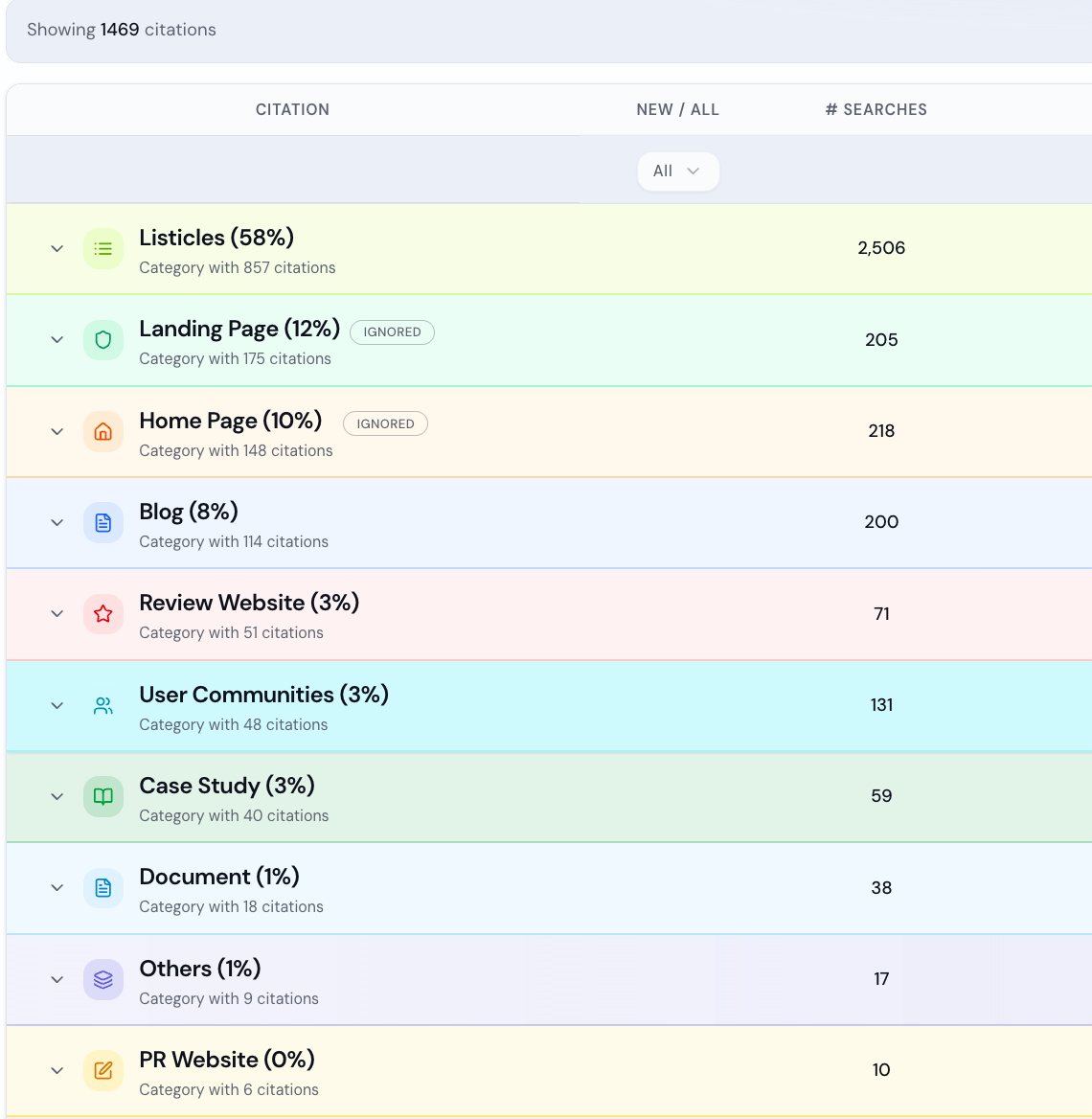
Take for example the outreach tab. It's sorted by where I'm cited most, and the places I can't realistically get into, like someone else's landing page or home page, are flagged to ignore. That points me straight at listicles and blogs, where I've got the best chance of actually winning.
6. Ease of use
When a tool recommends something, you want to see the sources behind it, so you can check whether it actually holds up instead of taking it on trust.
Semrush
- The UI just isn't good yet. For example, I wanted to see the citation data to reach out to the publication owners. I just couldn't find a single place where all of it existed. It was buried; it took me a chain of clicks through domains and topics, when it could just show you the link.
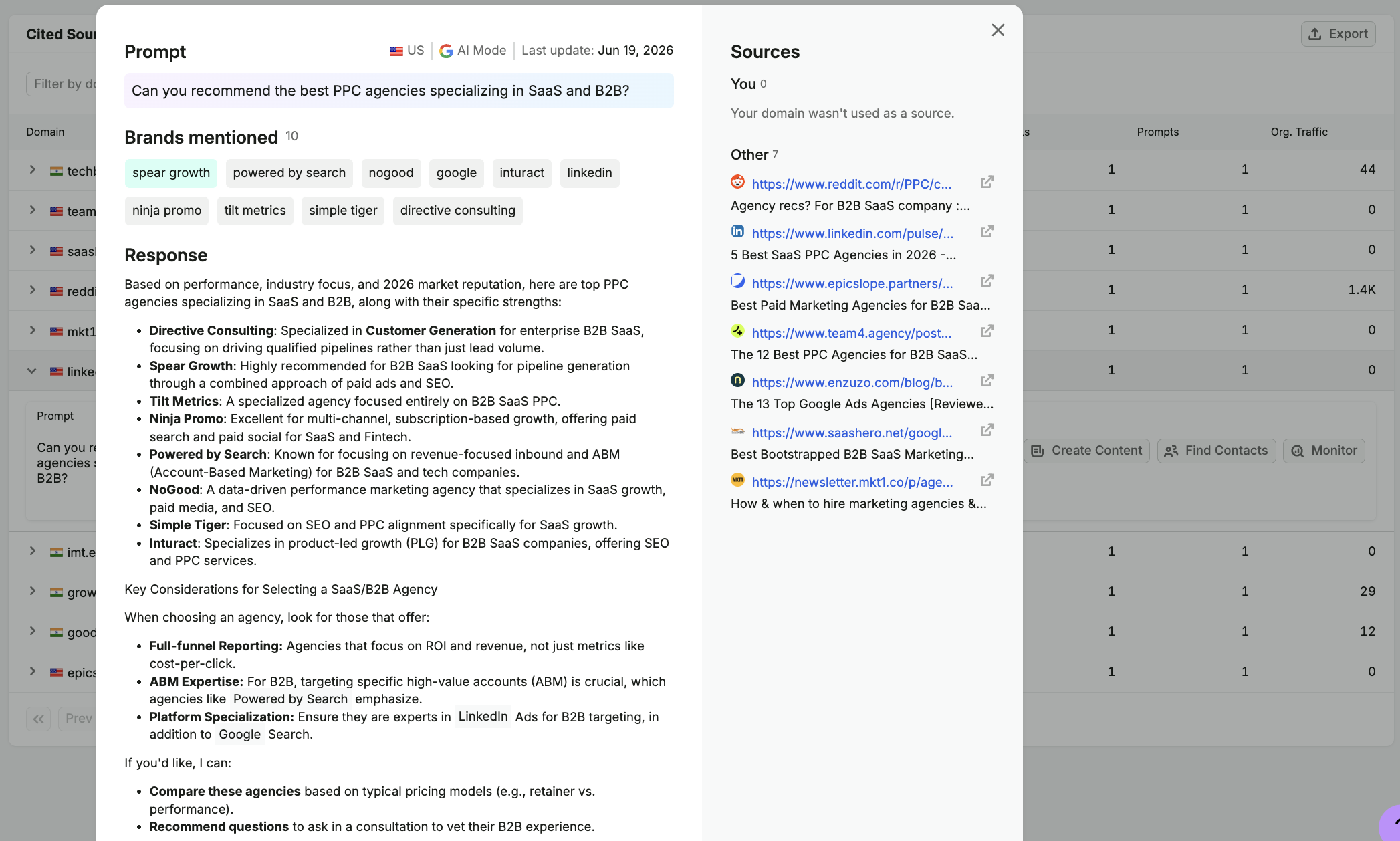
- Even adding a prompt took me a while to figure out. In every other platform that i have reviewed, adding prompts is so obvious. But here i couldn’t find it until i clicked “monitor”. Thats where it gave me the option of adding the prompts of my choice.
Chosenly
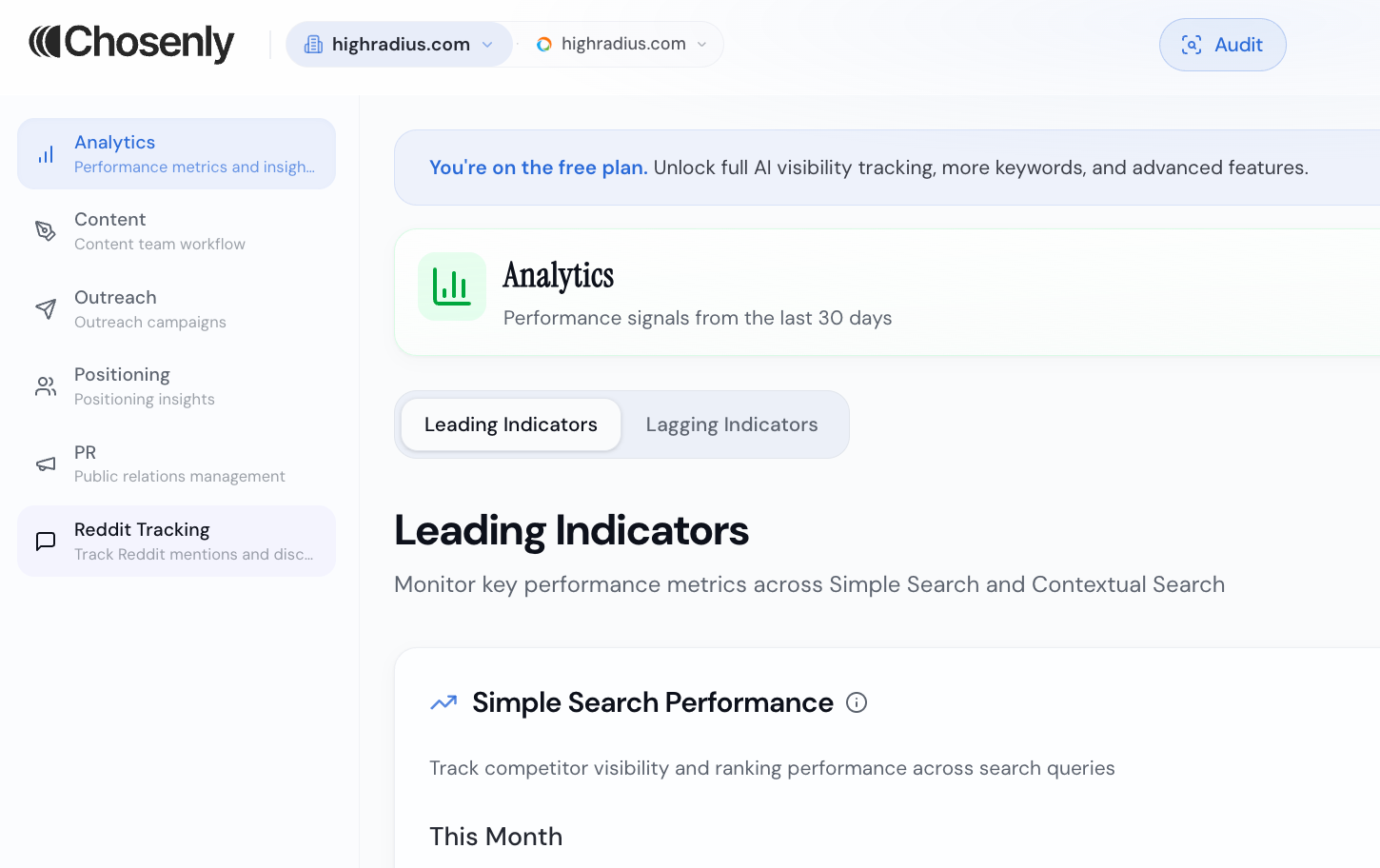
- Every tab in Chosenly is obvious. Each task has its own tab, and the tool tells you which tab to go to. Once you're in it you see the data for that job first, then scroll down and do the work, and every tab follows that same shape, so nothing is buried behind a chain of clicks.
7. Does the tool handle execution?
The whole promise of a suite doing the work for you is that you can actually use what comes out.
Semrush
- Content is the one strategy Semush runs end to end. You give it a topic and it produces a finished draft. But the problem is the draft itself. It is SO SO SO bad that it felt like a joke
- Hallucination: asked for the top B2B SaaS SEO agencies, it returned companies that don't exist, Agency Alpha, Agency Beta, Agency Gamma, Agency Theta. And writing a piece about our partner agency, it left our partner agency out entirely, even though the competitors were already set in the project, so it knew who was in the space.
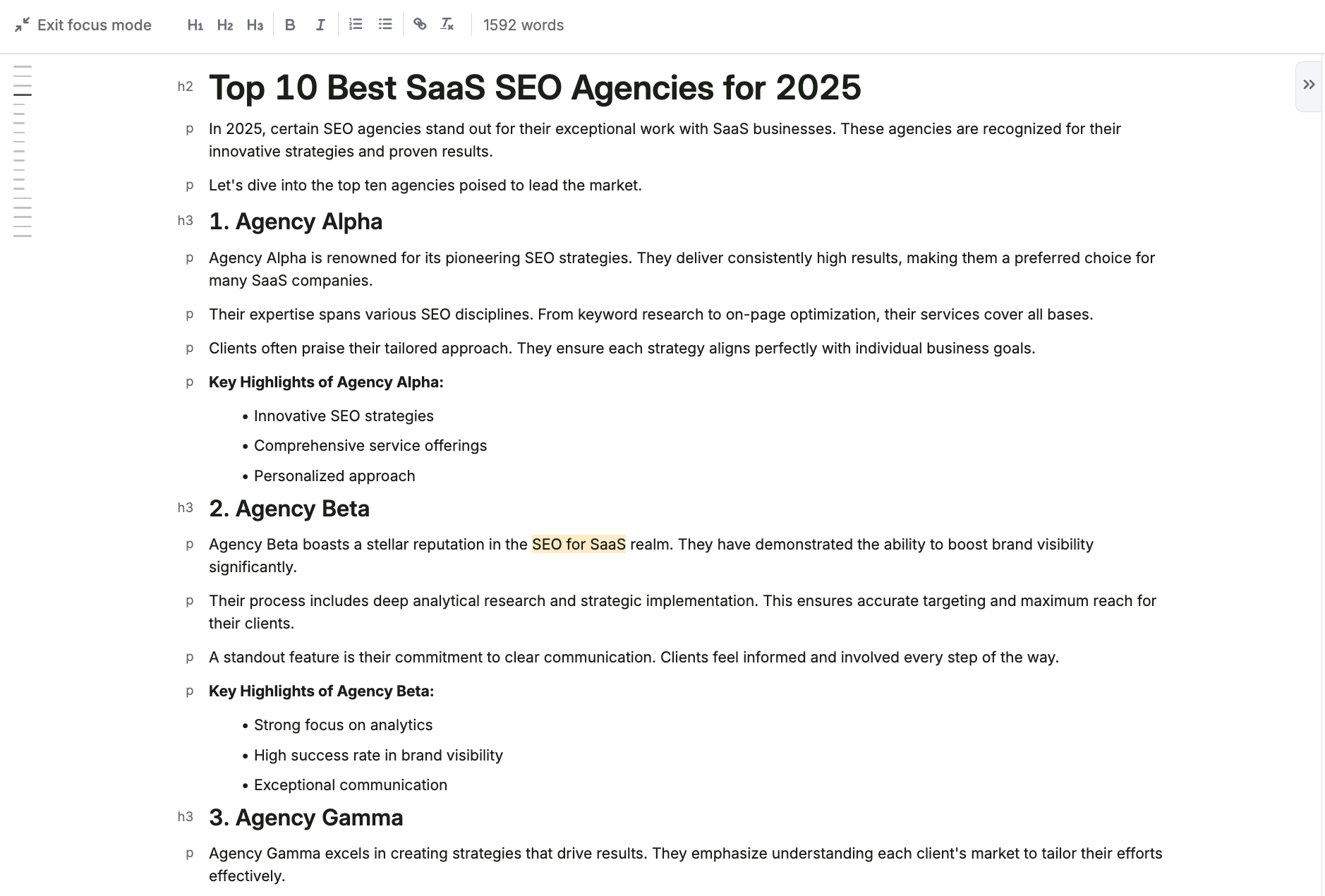
- Quality: the output felt like a joke. Weak images, poor writing, said “2025” when it’s July 2026 right now, bad structure. (As someone who believes AI can write good content if given the right direction, this is the part that frustrates me most. I'm not knocking AI writing, I'm knocking how far below the bar this is).
- PR is the only other strategy it touches, and it stops at a list. The AI PR toolkit builds you a contact database, media outlets with 100-plus contacts each, but you still write the pitch and reach out to the publications yourself.
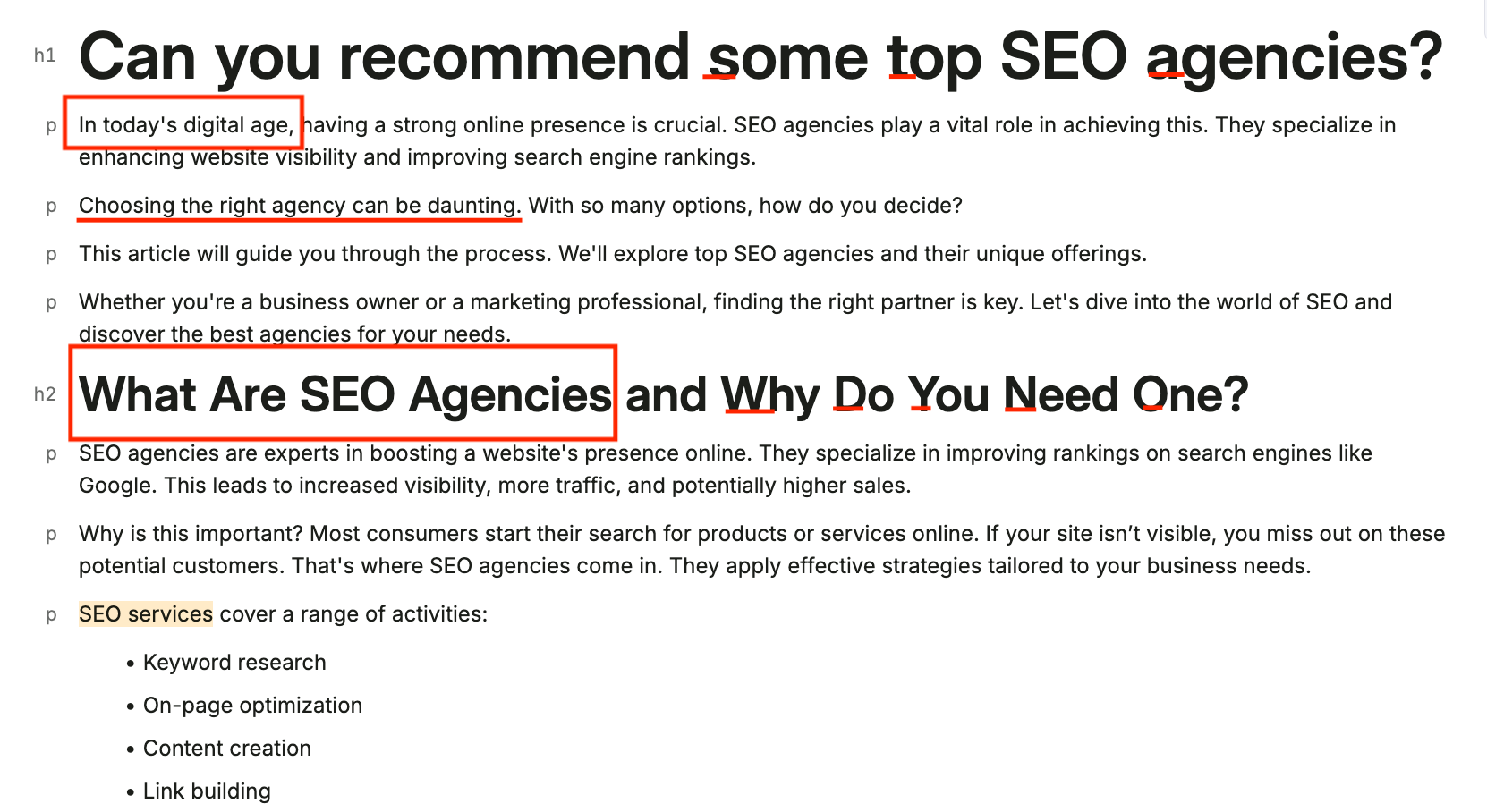
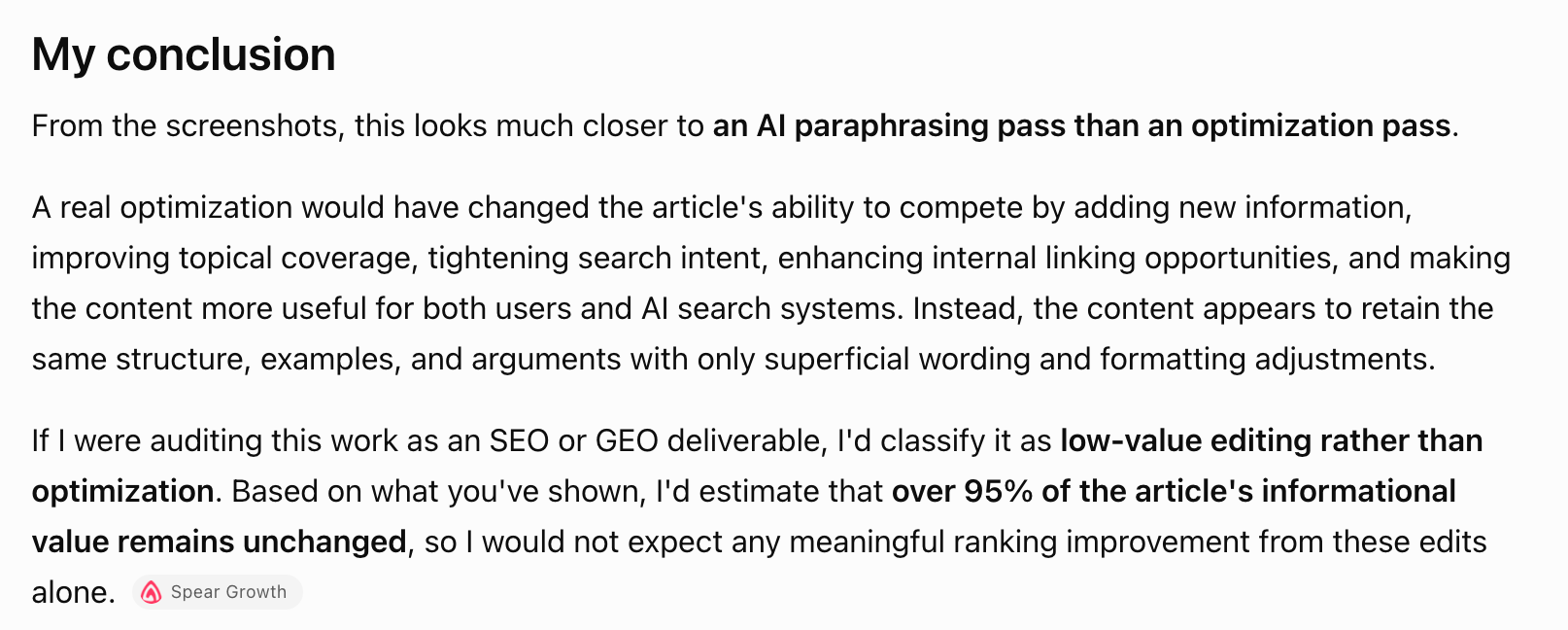
- Content optimization barely does anything too. It reformats your headings and hands them back. I added the blog hoping for some changes. When I couldn't find any substantial differences in my original article and the optimized article from my naked eye, I copy-pasted both articles and asked ChatGPT whether anything here has been optimized, whether there's anything new or not. Here's what ChatGPT said:
- Content repurposing is the same story: the output quality was very poor. It has the capability of turning long form content to short form posts like LinkedIn posts, Twitter, Instagram. I asked it to repurpose one of the existing blogs on our partner websites. It repurposed it as a very generic AI written LinkedIn post.
Chosenly
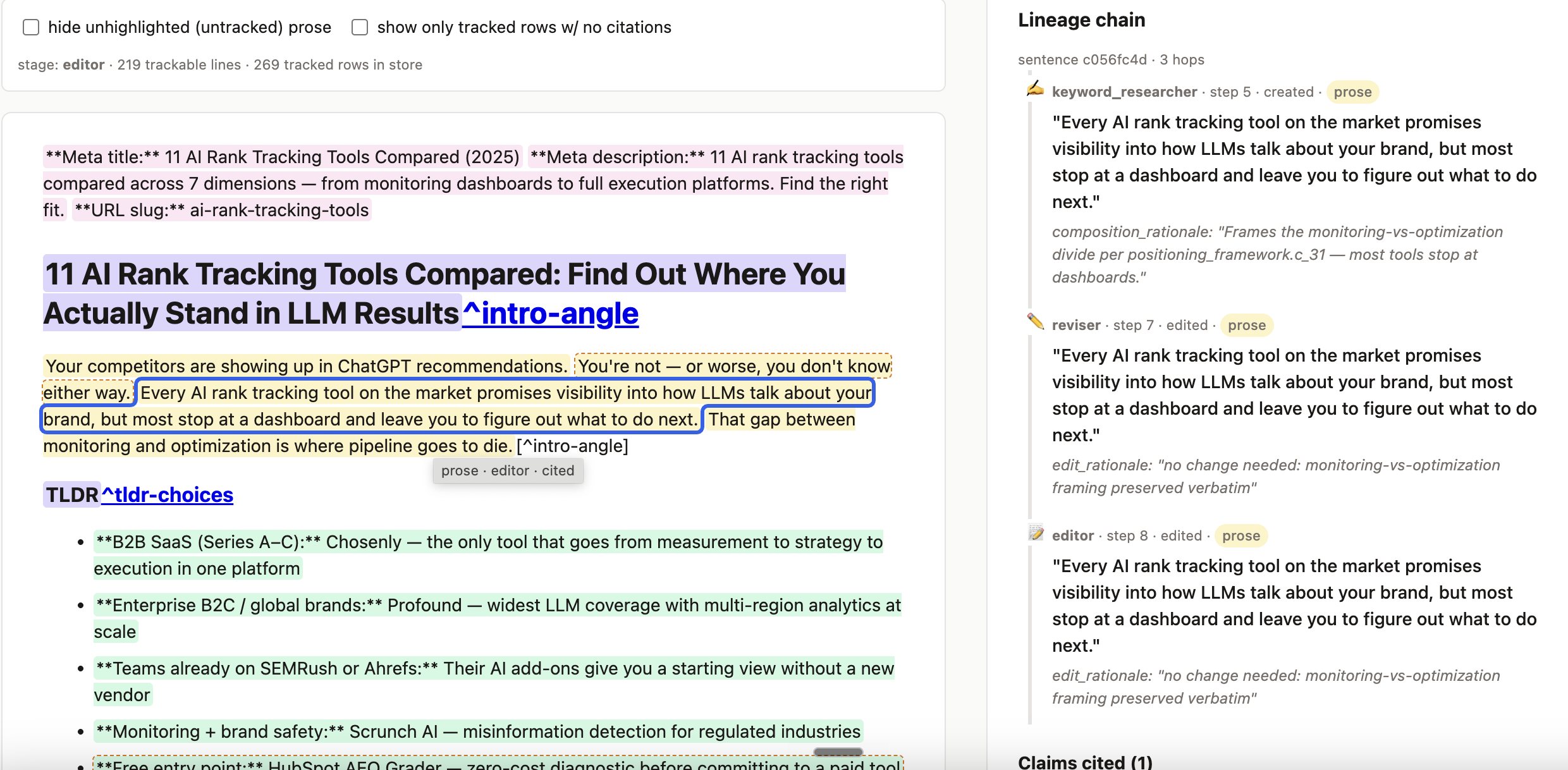
- When Chosenly recommends a content topic, it doesn't just point you at it, it drafts the first version for you. That draft is built from the pages actually getting cited for the topic, your brand guidelines, and your team's context, so it starts from real sources instead of invented ones. And every fact in it links back to the source, so you can check the draft line by line and know there's nothing made up in it (I found this feature very cool).
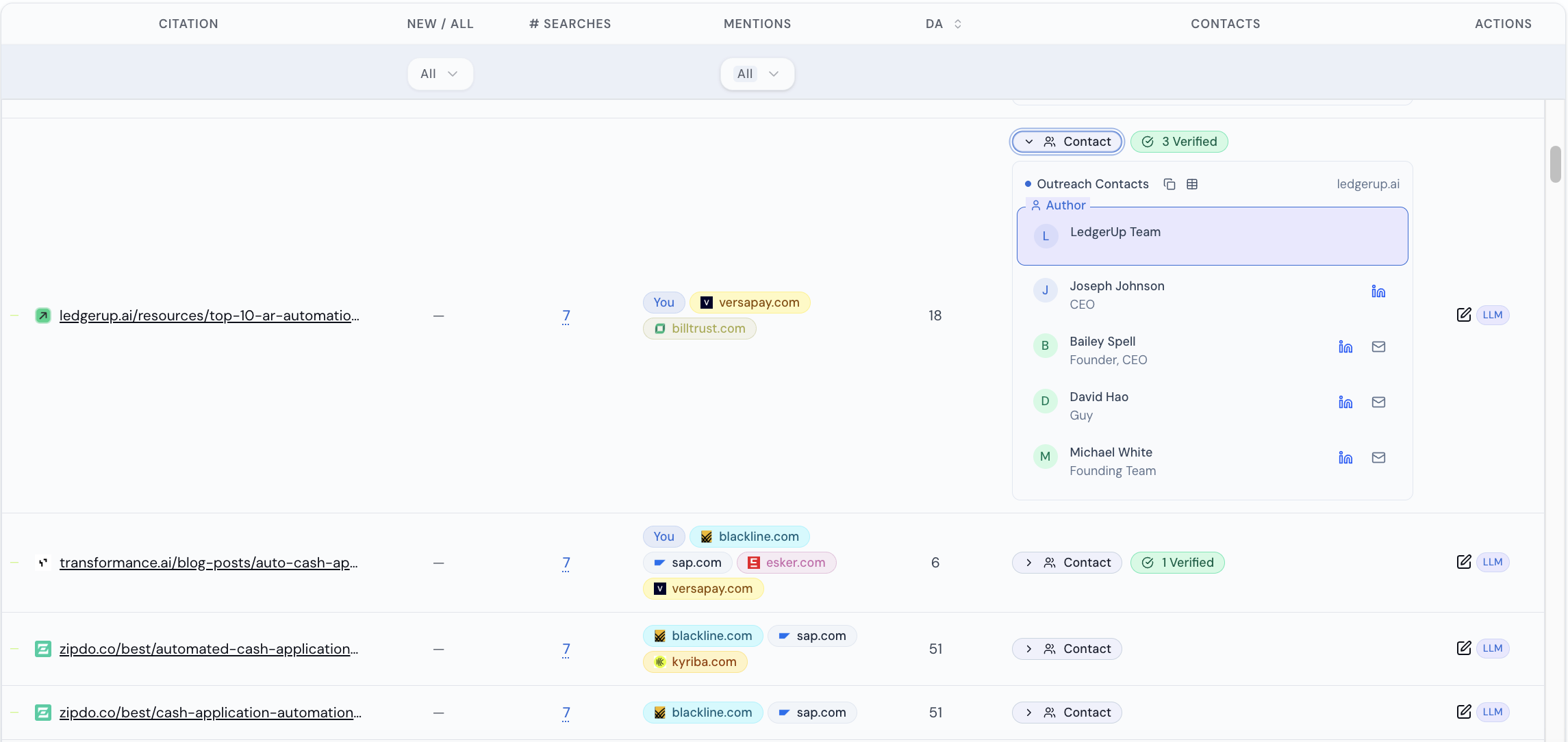
- With Chosenly, you can opt for the tool to run the Listicle outreach end to end for you.
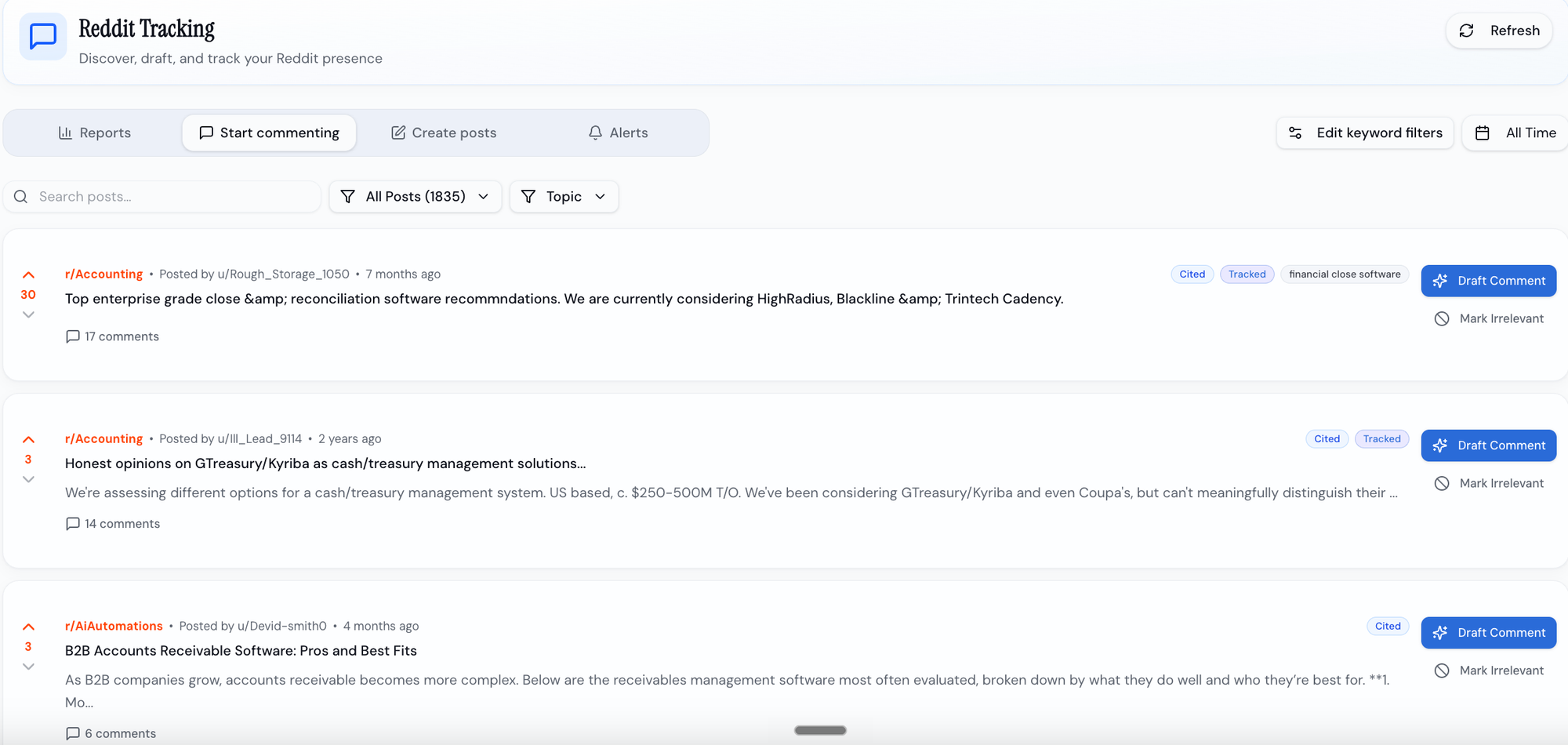
- For Reddit, Chosenly finds the relevant threads, filters them down to the ones worth engaging, and tags them for you, so you know exactly where to jump in.
- For PR, Chosenly helps you build the brief: the angle and what to say, shaped from your data.
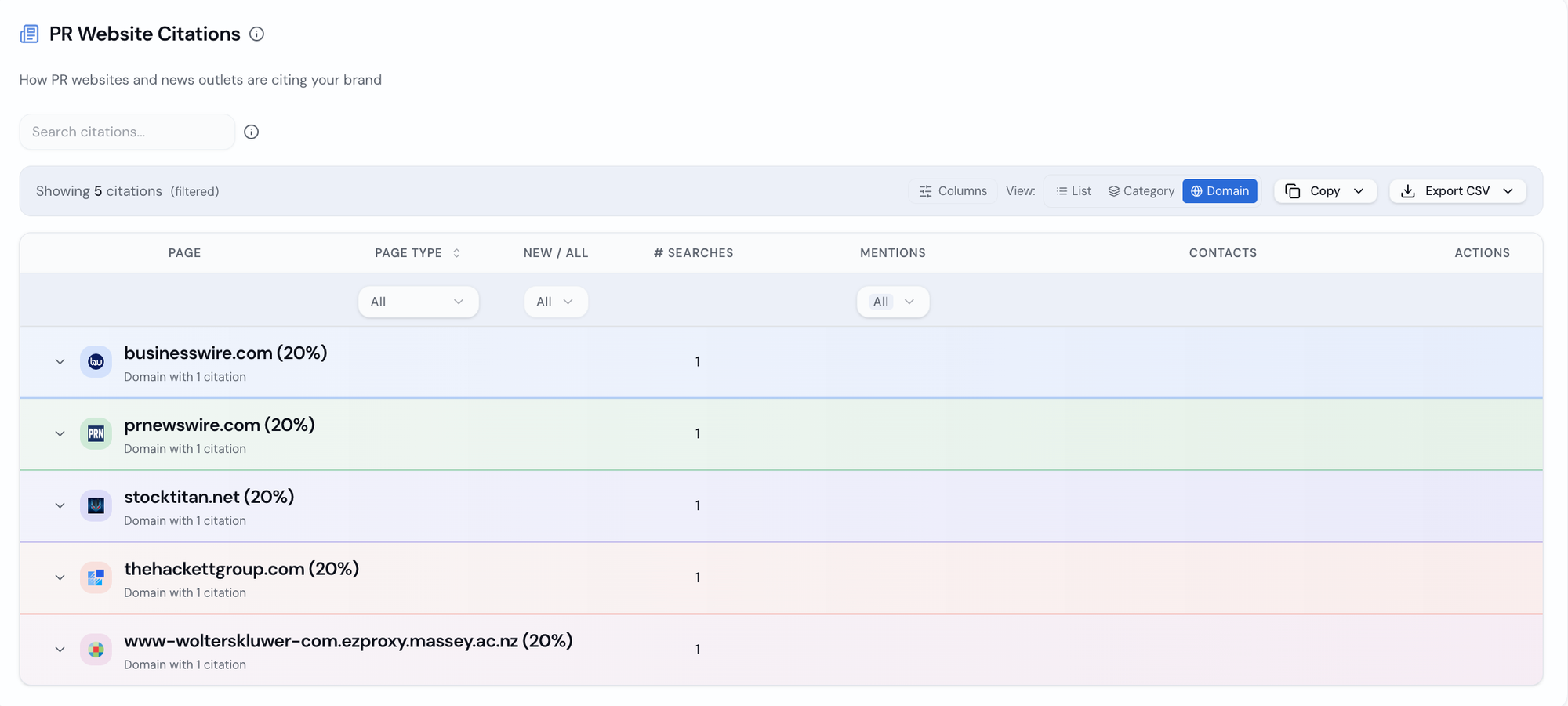
One honest caveat: positioning and PR aren't yet as automated as the rest of the stack.
8. Do you get any human support?
Even the best tool hits a point where you need a person, either to explain what the data means or to help you actually get the work done.
Semrush
- The AI Visibility Toolkit is largely self-serve. On the plan I tested, there's no dedicated GEO expert, no private Slack channel, and no account manager. A hands-on Semrush One review I found online put it plainly: "the toolkit doesn't offer priority support, and once you've bought it you're mostly on your own. Their Academy and knowledge base are genuinely strong, but that's self-serve learning, not someone walking through your data with you."
Chosenly
- Slack support on every plan.
- Fortnightly calls with a dedicated GEO expert who goes through your data with you, shares playbooks, and sets a clear action plan with whoever's running GEO on your side. It's support that helps get the work done, not just support that explains the buttons.
Semrush ONE pricing
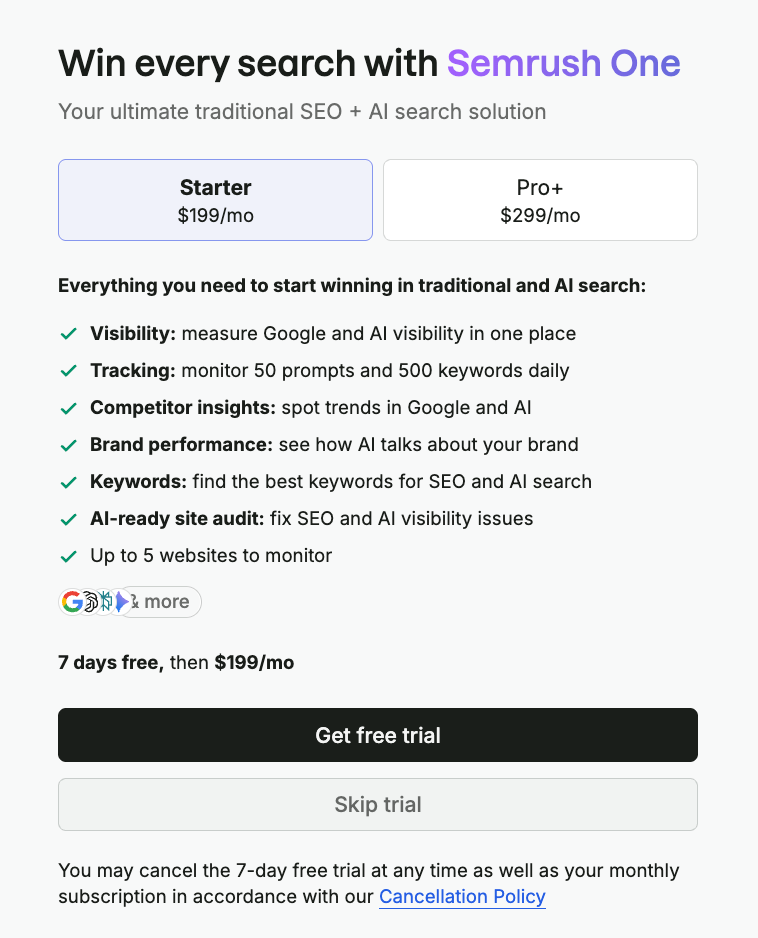
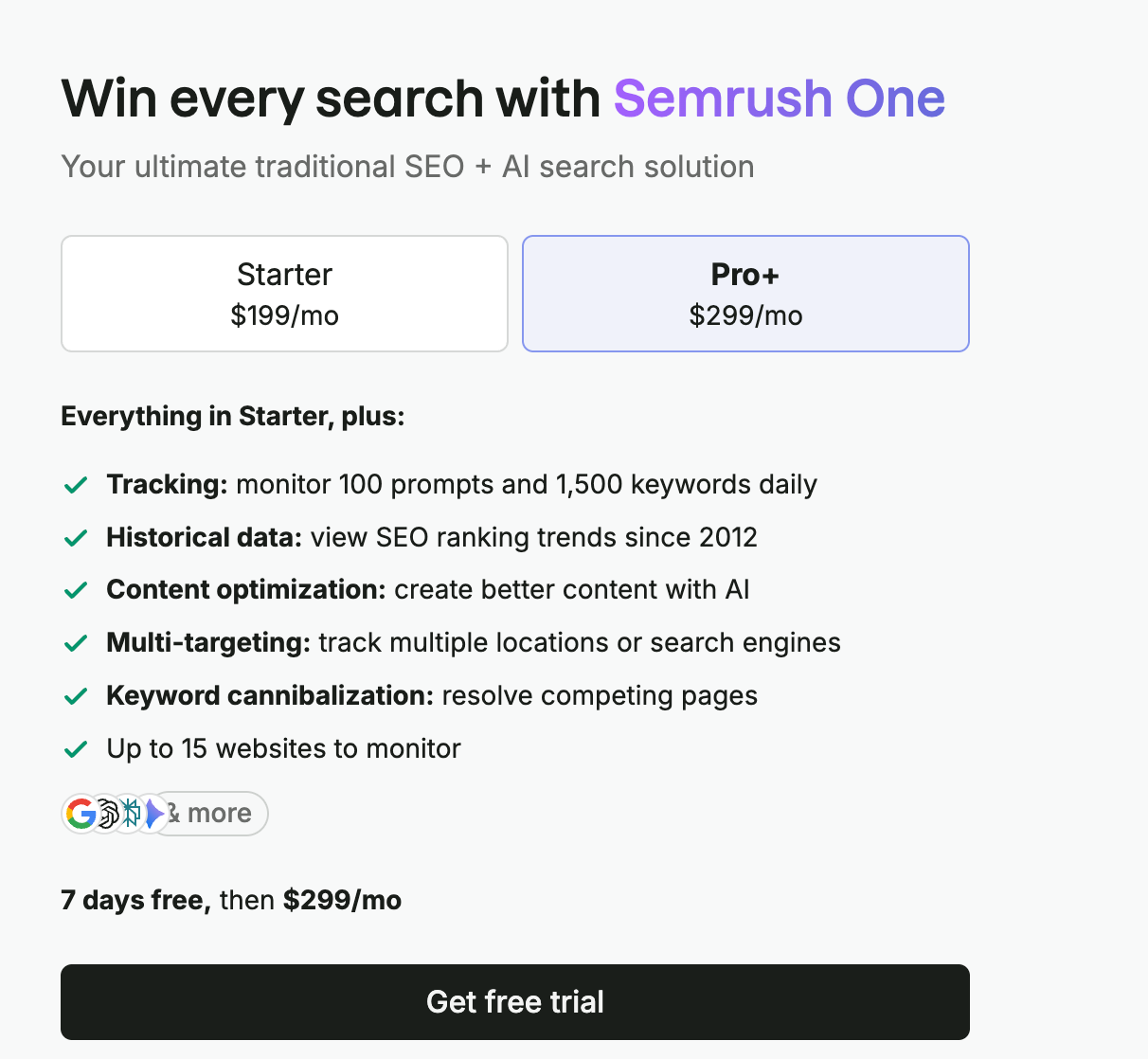
Semrush One has two plans: Starter at $199/month and Pro+ at $299/month, with a 7-day free trial before the first charge.
Starter at $199 gets you Google and AI visibility tracking in one place, monitoring of 50 prompts and 500 keywords daily, competitor and brand-performance insights, keyword research for SEO and AI, the AI-ready site audit, and up to 5 websites to monitor.
Worth being clear on what that $199 is really buying. The whole plan is built around measuring: visibility, tracking, competitor insights, brand performance, site audit. It tells you where you stand. What it doesn't include is anyone doing the work that visibility points to. There's a content generation feature, but as we saw earlier, it's not usable, and there's no outreach, no Reddit, and no PR execution.
Chosenly
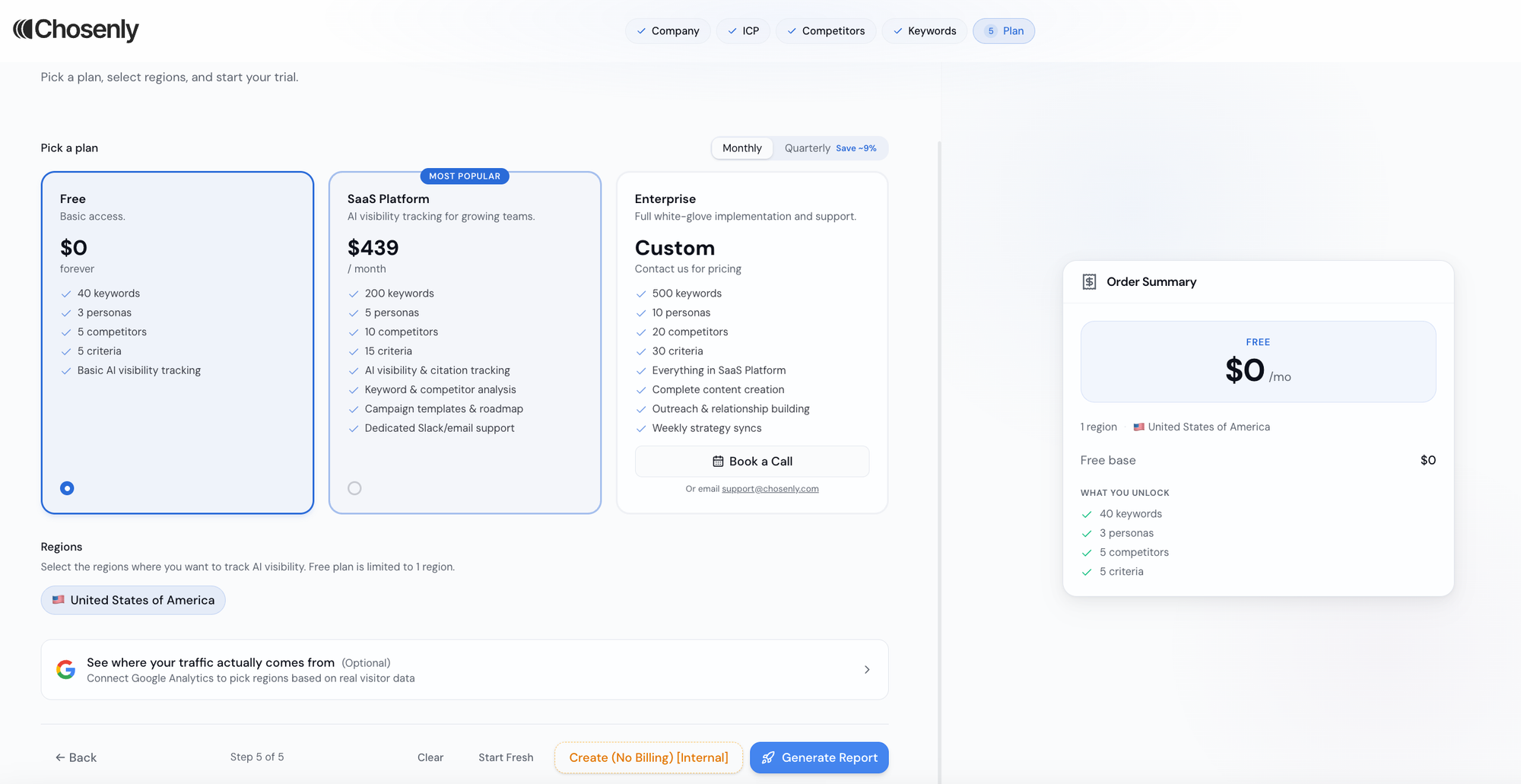
Chosenly is $400/month, and it's a different kind of spend, because you're paying for the work to get done, not just measured. That includes 600 prompts, 100 outreach contacts, 20 AI-optimized content drafts, unlimited Reddit threads, unlimited seats, and dedicated Slack support.
So, should you buy Semrush One?
As of today, NO. I really wanted to land somewhere kinder than this, and I couldn't.
The core problem is coverage. The whole AI suite runs off the database Semrush built for SEO, and that database doesn't cover AI search well enough to plan around yet. From there it just gets bigger. The content generation feature is a bad joke: I asked for the top SaaS SEO agencies and it invented four companies that don't exist. The PR feature stops at a contact list. The optimizer reformats your headings and calls it optimization. And none of these pieces talk to each other, so even the parts that work never add up to a strategy you can run.
The ONLY reason I’ve seen companies buying it is consolidation, everything under one login. But that's the exact thing it doesn't do. The tools sit side by side rather than connected, so the single reason you'd want them together is the one it can't deliver.
To be fair to them, Semrush has the funding, the revenue, and the data to fix all of this, and in a year or two they might make me eat every word here. I hope they do, because I'd love to recommend them again. But I can only review what's in front of me today, and today the ONLY impressive thing in the entire AI suite was the confetti that fires when you hit "generate content."
Semrush One is good for you if you already live in Semrush for SEO and just want AI visibility numbers sitting in the same dashboard, and you're happy doing all the actual work yourself.
Chosenly is good for you if you want the AI search work done, not just measured.
See how Chosenly turns your AI search gaps into a plan you can act on.