
Best Otterly AI Alternative for GEO | Pricing, Reviews, Funding and More
Otterly AI is one of the better AI search monitoring tools out there. But there's a catch. Here's our honest review.


TL; DR
Otterly AI reviews
If you search for Otterly reviews online, here’s what you’ll find:
"Because each engine-prompt combination is billed as a discrete capture event, tracking 200 prompts across five engines is effectively 1,000 data runs per reporting window. The output quality stays high, but the budget expands just as quickly. Teams that underestimate this relationship often find themselves rationing prompts or rotating focus areas rather than maintaining continuous coverage.”
The transition from this rich data to concrete action points for our content and dev teams requires a bit of learning. That's a lot of data in the dashboard and we had to iterate on our process initially because we started writing vague tickets such as ' improve AI visibility'. That taught us to get more specific quickly.

The reviews Chosenly has are in a complete contrast to Otterly.
“We closed a $120k USD client from ChatGPT. The best part was the lead said that they already trust us because ChatGPT deep research recommended us. I’ve only ever heard this when a lead comes from a human referral before this!”
— Founder, B2B SaaS Agency
“We put our trust in Chosenly after seeing their knowledge about LLM visibility was early on ahead of the established SEO analytics firms. That trust turned out to be well placed and after a few months we won our first 5-digit deal from LLM visibility”
— CEO, Fintech SaaS
Let’s dig into why is this the case.
How to pick the right AI SEO tool
Otterly AI vs Chosenly
There are seven things that decide whether an AI SEO tool is worth paying for. We tested Otterly AI and Chosenly against each one.
1. What does setup and TTV look like?
Setup and time to value are the gap between paying for a tool and getting anything back from it. The shorter that gap, the sooner the tool is doing what you bought it for.
Otterly AI
- The onboarding flow has bugs. Otterly AI login page asks you to enter your brand name, website, region, and competitors, and surfaces some competitor suggestions on its own. The auto-detection is mostly wrong, so most of the competitor list has to be added manually. The first time I tried it, the competitor screen vanished mid-setup and I had to start over.

- The wait for data is long and not communicated. The first time I onboarded, Otterly told us recommendations would take up to 3 days to populate. I assumed that was a worst case. The third day I logged in, recommendations were still loading. I tried this again the second time with a different brand, the dashboard sat in a loading state for 24 hours straight with no prompts visible and no indication of progress.
PS: I'm not the only one saying this. G2 reviews are saying this as well.

- You finish setup and don't know when the tool will start working. There’s no estimated time, no status indicator, no message telling you the status
Chosenly
- Chosenly uses an onboarding flow similar to Otterly's, but it’s more accurate. It connects to your GSC, and once you enter your personas and competitors, it works out your keywords and prompts on its own. If you already have an SEO plan, you can drop it straight into Chosenly and it builds a GEO plan from it. It also auto-filters the prompts that shouldn't be tracked, so you're not cleaning up the list by hand. You can add up to 200 keywords, which runs into thousands of tracked prompt variations once criteria are layered on, available even on the base plan. The whole flow takes about 5 to 10 minutes.

- You get usable data the moment you log in. A sampler is ready the second you sign in. It takes a limited slice of your data, around 25 keywords and 500 to 1,000 prompts once you account for all the variations, and gives you a working dashboard immediately. Recommendations, action items, and prioritization are all there from the start.
- Because Chosenly captures data that's specific to you, rather than pulling from a generic pool, the full report takes a couple of hours to populate. Check back the next day and it's ready.
- The data is always your own. Chosenly only ever captures data that belongs to you. There's no case where the dashboard is empty, and no case where the tool fills the gap with generic or made-up numbers. What you see is real and specific to your brand.
2. How reliable is the data the tool shows you?
Otterly AI
- Relies on plain prompt tracking. If your buyers ask the same thing fifty different ways (which is normal in B2B) you have two options, and both of them break your data.
- Option one: you add all fifty prompts. Now your visibility score is fragmented across fifty rows, and a real improvement on the underlying question shows up as a small bump on each of them instead of a clear move on the topic.
- Option two: you only track the five or ten phrasings you happened to think of when you set up the tool. Now you're measuring your performance on a tiny slice of how buyers actually search, and the prompts you didn't think of are completely invisible to you.
Either way, the score you're looking at isn't telling you the truth about where you stand.

- No filter for prompts that won't give a vendor recommendation. Every prompt you track contributes to your visibility score, including the ones where no vendor was ever going to be recommended in the first place.
- Prompt volume numbers don't line up with reality. I asked our partner SEO agency for the keywords with the highest search volume in their space, then cross-checked those against the volume numbers Otterly shows for the same terms. There was no meaningful correlation. The keywords our partner agency flagged as the highest-volume in the space didn't show up as high-volume in Otterly.

Every AI visibility tool starts with prompt tracking. The question is what you're tracking, and how. If you get this part wrong, your visibility score will move up and down for reasons that have nothing to do with what you actually did. You won't know if you got better, your competitor got worse, or the tool just picked up some random stuff.
Chosenly
- Other tools pull AI responses through official APIs, which don't always return what a real user sees in the actual ChatGPT or Perplexity interface. Chosenly doesn't depend on API access, so the data reflects real responses.
- Chosenly captures data specific to your brand rather than pulling from a shared or pre-scraped pool, so there are no gaps and nothing is padded with generic numbers.
- For prompt tracking, Chosenly tracks the seed keyword and the criteria your buyers evaluate on, which is what every variation for a prompt has in common. Your visibility score reflects how you perform on the actual question, not on some handful of phrasings happened to make it into the tracking list.

- Flags prompts that would skew your score. Some prompts never return a vendor recommendation, no matter how well you're optimized, because they're informational or too broad. Chosenly auto-filters the prompts that shouldn't be tracked, so you're not cleaning up the list by hand.
3. Which parts of AEO work does the tool support?
There are a lot of things you can do to improve your AI visibility. A tool that only covers a couple of them boxes you into a narrow playbook.
Otterly AI

Otterly genuinely covers more ground than most monitoring tools in this category. I have reviewed two so far (Peec AI and Scrunch AI) and i actually like the recommendations here. The breadth is real, and worth giving credit for. Here’s what it includes:
- A unified Recommendations queue that includes suggestions tagged for Reddit, YouTube, Content, Crawlability, Content Partnerships, Social Media, News & Media, and Entity. The recommendations themselves are good when you read them in isolation, a LOT better than most tools I've looked at in this space. Reddit recommendations in particular are one of the stronger implementations I've seen.
- A GEO audit, competitor sets, and tactic gaps.

- A crawlability checker for your site.
- A content checker where you paste a URL and get an AI-readiness assessment.
Chosenly
- Supports content creation, content updates, content repurposing, listicle outreach, Reddit, PR, and positioning.

3. How do you decide what to work on first?
GEO surfaces a lot of work like content, Reddit, listicles, crawlability fixes, brand misrepresentations. Even a small B2B company ends up with a hundred-plus recommendations. The tool's job is to tell you which one to do first otherwise you end up doing nothing.
Otterly AI
- Impact labels on the recommendation tab contradict themselves. The header on a recommendation says "high impact." Hover over it and the tooltip says "low impact." This is so damn confusing and there’s no way to tell which one to believe.

- No real prioritization across strategies. The recommendation dashboard was showing 232 Suggested recommendations sorted by "Impact: High to Low." The labels are there. The logic isn't. There's no answer to what makes a recommendation high impact, or what specifically you'll gain by acting on it.

- Otterly recommendations have filters (LLM, type of recommendation, area, and impact). We'll give Otterly credit for that. But filters are doing the work prioritization should be doing. By default, content, Reddit, crawlability, and social media are all mixed together. Without filtering to a single LLM, the queue shows the same recommendation four times for four engines.

- The same task shows up multiple times, once for ChatGPT, once for Perplexity, once for Copilot, once for Google AI Overviews. But you're writing one piece of content, that same piece of content should work for all AI engines. There's no reason to surface it as four separate tasks. Everything works ion silos and the result is a queue where the same work keeps reappearing under different engines, and you can't tell whether you've already done it or not.

Chosenly
- Tells you which three strategies to prioritize first.

- If the same problem shows up across ChatGPT, Perplexity, Gemini, and Copilot, Chosenly groups it into one recommendation. You do the work once.
- Every recommendation comes with the data that justifies the label. When Chosenly says something is high impact, you can see why. How many prompts it affects, the estimated traffic, the answer-influence score, which competitors it closes the gap on.
4. How well do the parts of the tool work together?
Everything inside a GEO tool should connect. Every module should read from the same picture of your brand, your site, and your competitors. When the modules don't talk to each other, you stop trusting any of them.
Otterly AI
- The crawlability checker and the recommendations disagree. Otterly's crawlability checker ran on our site and came back clean. Three days later, when the recommendations surfaced it mentioned crawlability issue as something I should fix. I have added the screenshots below. the audit it did was on 5th May and the recommendations surfaced on 8th may.


- The content checker doesn't know whose site you're checking. You can paste any URL, your competitor's, a random blog, a page with nothing to do with your brand, and Otterly will run an AI-readiness assessment on it. There's no validation that the URL belongs to you. But because it all works in silos, you can actually use this to audit any website you want. It's a nice feature to have, even though they'll probably patch it later 😉
Chosenly
- Every module in Chosenly reads from the same data. It’s built in a way that every insight speaks to the other. If one part of Chosenly finds something, every other part knows about it.

5. How much of the work does the tool do for you?
A tool that tells you what to do is useful. A tool that does it for you is more useful. GEO work falls into a few buckets: writing content, getting third-party mentions, posting on Reddit, fixing brand misrepresentations. The question is how much of this the tool actually handles versus how much it leaves for your team.
Otterly AI
- No content creation. Otterly just recommends you what topic to write on. Doesn't even gives you a brief.

- Outreach is handed off to a partner, not run inside the tool. Otterly's recommendations include a Pro Tip to sign up for Noble, their tech partner, to automate your outreach. So you're running two tools, onboarding with two vendors, and figuring out how data passes between them. Worth saying though: the previous two tools I reviewed didn't even do this much. Otterly at least acknowledges that outreach is part of the work and points you somewhere to get it done.

- Reddit support stops at the recommendation. Otterly surfaces Reddit threads where you should engage, but the drafting, the posting, starting new reddit threads is on your team.
Chosenly
- Drafts the content the tool recommends. When Chosenly says you should publish a page on a topic, it generates a first draft built from the top-cited pages for that prompt, your brand guidelines, and insights from your team.

- Runs third-party outreach inside the tool. Chosenly identifies which listicles and citation sources to get into, prioritizes them by traffic and answer-influence, finds the right contact at each one, drafts the outreach, and runs the outreach on your behalf.

- Drafts Reddit comments that respect Reddit culture. The tool finds relevant threads, groups them by what action they need, and drafts replies from your company information so the comments don't misrepresent you and don't get you banned.
- Chosenly figures out what existing pages in your website need a revamp and does the refresh itself on a click of a button.
Note: Positioning and PR are not yet as automated as the rest of the stack.
6. Does the tool provide any human support?
Even with the best tool, you will have moments where you are not sure what to do or need someone to actually run the work.
Otterly AI
- Support team is responsive as per G2. I didn't try it out myself.

- No option on any plan to have someone from Otterly do the work for you. The support team answers questions about how to use the tool. The execution is on your team.
Chosenly
- Available on Slack whenever you need help, not just during a fixed window.
- Fortnightly calls with a dedicated GEO expert scheduled around your availability. They walk through your data, share playbooks, and build a plan with whoever is running GEO on your team.
- Available on every plan, not just the top tier.
Otterly AI pricing vs. Chosenly pricing
Otterly AI
Otterly's published pricing is looks very competitive on the surface, but the first plan isn't really a plan you can use. Lite at $29/month that tracks 15 prompts. 15 prompts is not enough to run anything meaningful for a B2B company. There is 0 operational value you’ll get from this tier.
The first plan that lets you actually run Otterly is Standard at $189/month, which gets you 100 prompts. Premium at $489/month gets you 400 prompts.
A few things worth noting:
- Gemini and Google AI Mode are paid add-ons on every plan, not part of the base subscription.
- Extra prompts cost $99 for 100, charged on top of whatever plan you're on.
- Each prompt tracked across multiple engines counts separately.

Chosenly pricing
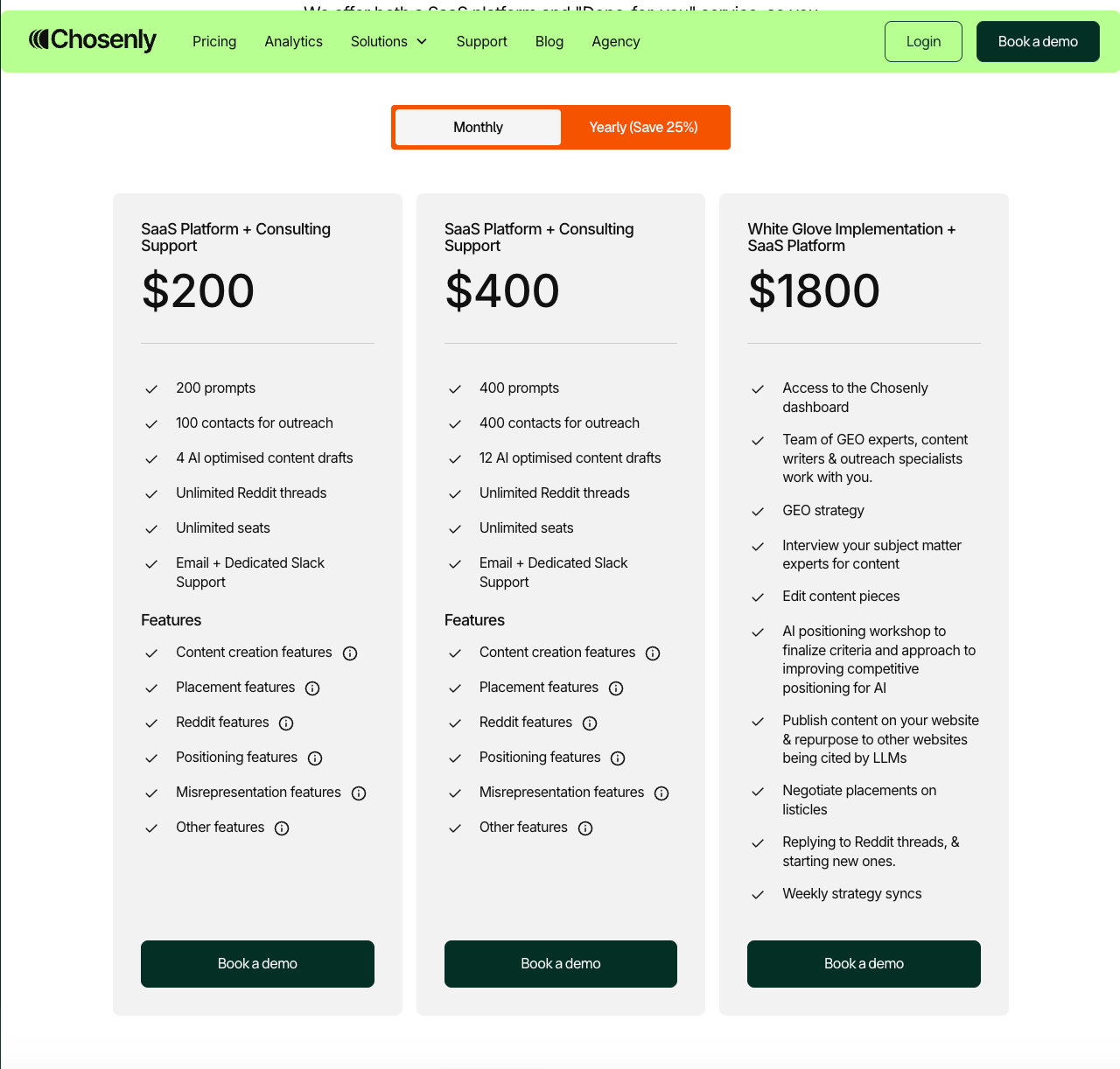
Chosenly starts at $200/month for the SaaS platform with consulting support. That includes 200 prompts, 100 outreach contacts, 4 AI-optimized content drafts, unlimited Reddit threads, unlimited seats, and dedicated Slack support.
Chosenly costs more than Otterly's Standard plan. But in $200/month with Chosenly you get more automations, 6x the prompts of Otterly's Standard plan, plus the things Otterly doesn't include at any price: outreach contacts, content drafts, Reddit threads, and a dedicated GEO expert.
Verdict: Chosenly vs Otterly AI - Which tool is better for you?
Otterly AI is one of the better monitoring tools in this space, and it's worth saying that up front. Even Otterly’s tagline is. The #1 rated AI search monitoring platform” which i also agree on. But if you want something actionable, then Otterly wont be enough.
The problem is that Otterly is a monitoring tool with a recommendation engine added on top. The recommendations are good, but the tool was built to show you data first and then it figured out the rest later. Chosenly was built for taking action from the start. The UI for doing the work, the contacts for outreach, the content automation, the Reddit workflow, none of that was bolted on.
Every tab in Otterly works in silos. The crawlability checker doesn't talk to the recommendations. The recommendations don't talk to each other. The content checker doesn't know whose site you're checking. You end up with a tool that has a lot of good parts, none of which know the others exist. And the moment you try to act on what Otterly shows you, the work moves out of the tool and into your team's manual queue.
Pick Otterly if budget is your main concern and you don't need the tool to do the work for you.
Pick Chosenly if you're a B2B company that wants the work to actually get done, not just measured.
FAQs
How does Otterly AI work?
Otterly AI is an AI search monitoring tool. You enter your brand, your website, your region, and your competitors, and you give it a set of prompts you want to track. Otterly runs those prompts across AI engines like ChatGPT, Perplexity, Google AI Overviews, and Microsoft Copilot (Gemini and Google AI Mode are paid add-ons), captures the full AI response for each one, and logs whether your brand was mentioned and which URLs the engines cited as sources.
From that data, Otterly builds dashboards showing your brand visibility over time, your sentiment in AI responses, how often each of your competitors appears, and which pages on the web are getting cited most. It also surfaces a queue of recommendations — things you could do to improve your visibility, like publish a new page on a particular topic, engage on a Reddit thread, or fix a crawlability issue.
Otterly tracks data and gives you suggestions. The execution, including writing content, running outreach, and posting on Reddit, is on your team.
What are the best AI search monitoring tools?
The "best" tool depends on what you actually need from it.
For monitoring only (you want to see how you show up in AI search and act on it yourself), the strongest options are Otterly AI, Peec AI, and Scrunch AI. All three do prompt tracking, citation analysis, and competitor benchmarking well. Otterly has the most breadth of the three, including a Reddit recommendations module and YouTube coverage. Peec is well-funded and clean. Scrunch is strongest for technical AI crawlability work.
For monitoring plus execution (you want the tool to surface what to do and then help you do it), Chosenly is the option built for B2B teams that want to act on the data, not just measure it. It includes content drafting, outreach automation, Reddit automation, and a dedicated GEO expert as part of the plan.
If you're early in your GEO journey and your team has bandwidth to execute, a monitoring tool is a reasonable starting point. If you're past that stage and want the work to actually move, you'll outgrow monitoring quickly.
Want to see Chosenly in action?